Corporate Power

Sign for Northern Pulp at the entrance to the Pictou County pulp mill declaring Northern Pulp is a Paper Excellence company. Photo from 2021.

This article was first published by the Halifax Examiner on August 25, 2025. 

Article summary:
• Over the lifetime of the Northern Pulp mill, Nova Scotia lost hundreds of millions of dollars because of incompetent, naive, and complicit governments.

• As Northern Pulp’s billionaire Indonesian owners have opted not to build the new mill and instead allow the company to go into bankruptcy, 420,000 acres of Nova Scotia forest land are up for grabs.
• A shadowy company called Macer Forest Holdings has placed an under-valued bid of $104 million on the land.
• A Macer-affiliated company called Acadian Timber looks poised to log that land.
• One of Acadian’s board members, paid $56,000 annually, is Karen Oldfield, the interim president and CEO of Nova Scotia Health.
• Maurice Chiasson, a lawyer who represented the province in the Northern Pulp insolvency hearings, is now representing Macer Forest Holdings in the very same court process.
• As the government is mandated to protect 20% of the province and is far short of meeting that obligation, buying back the Northern Pulp land presents an inexpensive opportunity to meet that goal.


It was clear from the start of Northern Pulp’s insolvency case filed in the British Columbia Supreme Court six months after the Northern Pulp mill closed, that the outcome was never going to be good for Nova Scotia.

Spoiler alert: the outcome is not only not good, it’s downright bad.

Legal giveaways and concessions by successive generations of Nova Scotian governments to the various large foreign owners of the pulp mill meant Northern Pulp had all kinds of legal recourse to punish Nova Scotia for not amending the 2015 Boat Harbour Act, and not allowing the mill to continue to pump toxic effluent into Boat Harbour, which had despoiled the Pictou Landing First Nation estuary for half a century.

When Northern Pulp failed to come up with a viable new effluent treatment system that passed environmental muster by the deadline of 2020, the mill had to shut down.

Read more

A giant white pickup truck with raised suspension and massive wheels is parked in front of a small black car on a gravel parking lot.

This article was first published by the Halifax Examiner on October 28, 2024. It is the third and final article in a series looking at the ongoing trend in North America for ever bigger and taller pickups and SUVs, and some of the problems these pose both for human health and safety, and for the health of the planet. In this article we look at what governments in Canada could, at least in theory, do to tackle the bloat. Part 1 is available here and Part 2 is available here.

For 10 years Ben MacLeod watched from afar what was happening in his home town of Halifax, and was pleased to see HRM Council undertaking “progressive initiatives” on traffic safety, and the “gradual construction of the bike lane network.”

“It was exciting to see them moving in the right direction,” he said in an interview.

MacLeod, an urban planner and sustainable transportation advocate, had moved to Hong Kong in 2012, and in 2022 moved back to Halifax, where he grew up.

“I was excited to come back to see what’s changed,” he said.

What MacLeod didn’t bargain on, what made him “a little bit shocked” when he got home, however, was the “design trends” in the vehicles on the roads, and how prevalent big vehicles had become.

“Eighty-six percent of new vehicles in Canada are now SUVs [sports utility vehicles] and pickup trucks, which is shocking,” said MacLeod, who doesn’t own a car and mostly gets around on foot or on bicycle.

Read more

A screenshot from the GHI website, divided vertically into two squares. On the left, on a black background, in white print, the words "SPIRIT OF SCOTIA" and "Positioning Nova Scotia as a global leader in green hydrogen production." On the right side of the image, a photo with blue sky, blue ocean and three large wind turbines in the ocean, and a white frothy wake from a boat leading to them.

This article was first published by the Halifax Examiner in November 2022, but the underground grab of mineral rights in Nova Scotia by “green hydrogen” entrepreneurs escaped broad public notice at the time. CBC is now picking up on the story of possible hydrogen storage in underground salt caverns in Newfoundland and Nova Scotia, so I’m republishing this article about the grab of Nova Scotia’s underground on my website. This way it can also be shared on Meta Platforms, which are blocking media in Canada.

It doesn’t take long to find the thousands of claims that green hydrogen companies have staked on the Nova Scotia Registry of Claims (NovaROC) map, once you realize they’re there.

Since early 2002, at least three companies have been taking out exploration licences covering more than 100,000 hectares (more than 250,000 acres) of Nova Scotia.

Unlike so many of the other exploration licences that cover the province, which are concentrated around historic gold mines and possible deposits of gold and a few other metals, these recent licences are clustered primarily in areas with salt deposits.

“There are no special conditions on these licences,” says Natural Resources and Renewables spokesperson Patricia Jreige in an email. Nor is there a limit to how many licences one company can take out.

Jreige explains that exploration licences are issued for two-year terms, and licence-holders must submit a report of work done and data collected on the claims, and pay a renewal fee that increases the longer the licence is held. The current fee per claim is $10, and an exploration licence can include up to 80 adjacent claims, says Jreige.

Some of the recent licences taken out by green hydrogen operators near Port Hawkesbury are in water supply areas. When that is the case, Jreige says the utility operator is to be notified.

Salt caverns are often used to store hydrocarbons, and Nova Scotians have not forgotten the highly controversial project by Alton Gas Natural Gas Storage project, which planned to flush brine out of salt caverns near Stewiake, and dispose of it into the Shubenacadie River.

There was intense Mi’kmaw opposition, spearheaded by the Grassroots Grandmothers, to the Alton Gas project, and it was cancelled in 2021.

Now, however, underground salt deposits throughout Nova Scotia are being claimed by people eager to get into the production of “green” hydrogen.”

The Nova Scotia government's official Registry of Claims (NovaROC) map from 202 showing mineral and exploration licenses in the province, in green, on a white background.

The Nova Scotia Registry of Claims (NovaROC) map showing mineral exploration and mining licences in November 2022.

Read more

Sign at the entrance to the Pictou County pulp mill declaring Northern Pulp is a Paper Excellence company. Photo: Joan Baxter

Sign at the entrance to the Pictou County pulp mill declaring Northern Pulp a Paper Excellence company. Photo: Joan Baxter

This is how the “Friends of a New Northern Pulp” describe themselves on their website:

We are Nova Scotians who care deeply about our province, our forests, and our communities. We are the 36,000 Nova Scotians who own small and large woodlots.

So, just one line in and the BS begins.

The wording of the second sentence suggests that every one of the 36,000 small and large woodlot owners in the province is a “friend” of a “new Northern Pulp.”

If this statement were true, then I — as a woodlot owner — would count among the “friends” of the “new Northern Pulp.”

What is the “new Northern Pulp” anyway? If it’s the company they’re talking about, it looks an awful lot like the old Northern Pulp.

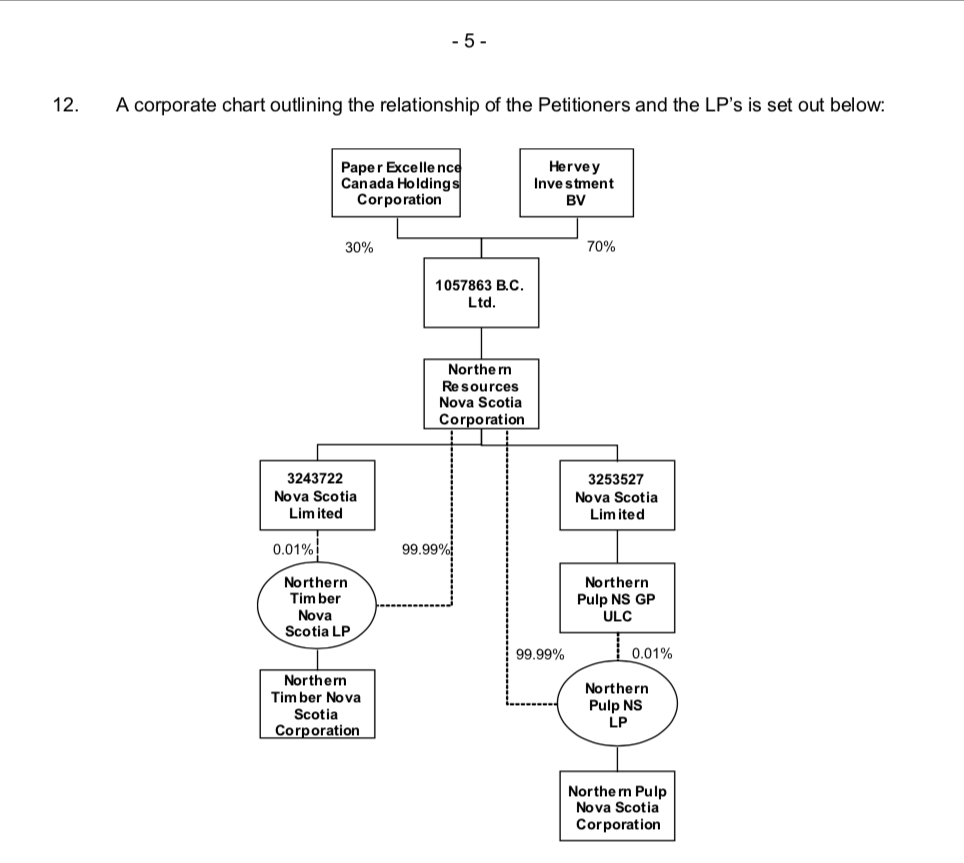
Northern Pulp’s recent submissions to the BC Supreme Court show it’s still the same old Paper Excellence company, one of whose declared “owners” is just an address in a popular tax haven (The Netherlands).

Corporate structure of Paper Excellence from Bruce Chapman 2020 affidavit to BC Supreme Court

Corporate structure of Paper Excellence from Bruce Chapman 2020 affidavit to BC Supreme Court

Read more

November 18, 2019

Morila gold mine in Mali, West Africa, 2002. Photo: Joan Baxter

This book chapter is the result of a visit to the Morila gold mine in Mali nearly 18 years ago, and is excerpted from my 2010 book, “Dust from our eyes – an unblinkered look at Africa,” published by Wolsak & Wynn in Canada and worldwide by Fahamu Books, which was shortlisted for the Dayton Literary Peace Prize in 2009. I decided to republish it here because I regret to say that based on the extensive research I’ve been doing on the gold mining industry in the past few years, it looks as if not much (if anything) has improved since then. I first wrote this story for the BBC, following a visit to the Morila gold mine when it was operated by South Africa’s AngloGold and Randgold. Today, the Morila gold mine is operated by Canada’s Barrick Gold, and is a “joint venture company held by Barrick (40%), AngloGold Ashanti (40%), and the State of Mali (20%).” The economic disparities, and the environmental, social and political havoc that such gold mines cause, are all contributing factors to the horrendous insecurity that now prevails in Mali, Burkina Faso and Niger (where Canadian gold mining companies are so prevalent), causing widespread suffering – and death. If I were writing it today, I would probably entitle it, “Gold: all that glitters causes death and devastation.”

All that glitters … is taken away

… the very term investment badly distorts what’s really going on. Plundering, looting and exploiting the non-renewable resources of Africa is a far more accurate description. Gerald Caplan

In my fifth year in Mali, in late 2002, I finally obtained an invitation to accompany the country’s new minister of mines and a team of Malian journalists on a day trip from Mali’s capital Bamako to Morila, the country’s newest big gold mine.

On the short flight to the mine, I found myself seated beside a South African employee of the South African mining giant Randgold, who told me he and his wife had recently applied for Canadian citizenship and that he now lived in Toronto – when he wasn’t in Mali. He said things were deteriorating in South Africa, “if you know what I mean,” and that he and his wife, as white South Africans, felt their futures were in Canada.

He went on to tell me about the wonders I was about to experience at Morila, especially the man-made lake that was filled with water pumped 40 kilometres from a small river, a tributary to the River Niger. And as for the clubhouse, that was something to behold; he was very proud of it because he helped to design it. He called it the “Sahelian Club Med.” There were pleasure craft and a wharf on the man-made lake, he said, and lovely watered gardens, a fine bar and restaurant, with food, wine and other drinks flown in from South Africa. He said he often drove down from Bamako in his Land Cruiser to spend weekends there.

Read more

This article first appeared in the Halifax Examiner on March 5, 2019.

Northern Pulp effluent flows into the Northumberland Strait at a dam called Point D. Photo: Joan Baxter

There is much to wade through in the documents that Northern Pulp submitted to Nova Scotia Environment on February 7, 2019, when it registered its “Replacement Effluent Treatment Facility” for a 50-day, Class 1 environmental assessment (EA).

Citizens who wanted to comment to the government on the proposal, as was their right, needed to slog through 1,586 pages in 17 registration documents, and they needed to do it quickly. The public was given only one month to comment. Environment Minister Margaret Miller had until March 29 to decide on the project. [Minister Miller’s decision is detailed here.]

Not surprisingly, the EA submission starts on a very encouraging note. In the Executive Summary, Dillon Consulting, which developed the project documents on behalf of Northern Pulp, provides a table indicating the “significance of project-related residual environmental effects” on 18 items, everything from the atmosphere to marine fish and fish habitat at every stage of the project, during construction, operation and maintenance, or because of accidents or malfunctions.

Every single one of them is assessed as NS, or “No Significant Residual Environmental Effect Predicted.”

Every. Single. One.

This could mean either of two things.

Read more