Climate

A grey-haired man wearing a navy blue suit and red tie stands unsmiling behind another grey-haired man, with a wide smile, who is seated on a brown upholstery chair and signing a large red book. In the foreground on the desk are bouquets with orange, blue, and yellow flowers. On the wall behind the standing man is a painting of a landscape in a gilt frame, and on either side, an array of drooping flags, including the American stars and stripes on teh far left.

Prime Minister Mark Carney signs the White House guest book as President Donald J. Trump stands behind him in the White House on May 6, 2025. Photo by Lars Hagberg, provided by the Office of the Prime Minister © His Majesty the King in Right of Canada, 2025 (non-commercial use).

This article was first published by the Halifax Examiner on Dec. 18, 2025. Since then, the situation hasn’t improved, and Prime Minister Carney has stepped up the assault on the public service. Thousands of notices have gone out to federal public employees across government departments, slashing key climate and environmental research and policy programs. Those whose main source of information is National Post publications and other incurious, corporate and right-leaning media, tend to defend the cuts, parroting those media and social media messaging that glibly disparage the federal civil service as “bloated.”

Few would argue that there is always room for improving effectiveness and efficiency of large organizations – be they government departments or corporate bureaucracies. The Liberal government’s deep cuts to the public service is not that. It is a blunt force assault on crucial federal research and policy work, especially on anything involving environment, climate and sustainability, which looks more ideological than strategic. It is anything but well thought-out planning for an increasingly precarious future in a climate and biodiversity crisis, with a former neighbour and friend turned threatening foe.

In his much-touted and acclaimed speech at the World Economic Forum in Davos, Switzerland in Jan. 2026, Carney didn’t breathe the word “climate,” and referred only tangentially to the U.N. Conference of Parties (COP) that meets annually to hammer out policies to tackle the climate crisis, which he said was another of the multilateral institutions that is now “under threat.” Yet Canada’s prime minister didn’t bother attending the 2025 COP in Brazil

Carney’s Liberals are doing the work of Conservatives, pleasing moneyed moguls and their cheerleaders by making deep cuts in Environment and Climate Change Canada, Infrastructure, Housing and Communities Canada, Fisheries and Oceans Canada, Agri-food and Agriculture Canada, Global Affairs Canada, and the Canadian Food Inspection Agency that reports to the Minister of Health, among others. Carney’s government is cutting seven key agricultural research facilities, cuts the National Farmers’ Union calls “disastrous.” This includes  Nova Scotia’s Nappan Research Farm in Cumberland County, established in 1887, which does important forage and climate research.

By weakening the public service and Canada’s own research and scientific capacity that leads to strong federal policies and protections for Canadians, Carney is doing the opposite of nation-building, and making this country stronger in the face of continued threats from our increasingly hostile neighbour to the south, led by a volatile and unhinged bully.

It’s a long read, because it’s a long and complex story … 

The Carney way

It’s beyond terrifying watching U.S. President Donald Trump and his bullying, brash, and crass coterie of odious hatemongers destroying decency, building autocracy, and dismantling democracy to Canada’s south.

The trouble is that it can be all-consuming watching the gilded, gold-plated shitshow in the U.S. That means it’s easy to miss what’s happening closer to home.

Liberal democracy is a fragile thing that can be undermined in many ways. Not all star a malignant narcissist spewing non-stop lies and insults, working with a tyrannical cabal of billionaires, tech bros and bigots and sycophants, to unleash non-stop “Truth Social” turmoil on a country – and the planet.

Democracy and genuine human progress on social, environmental, and climate issues can be weakened much more quietly, subtly, and methodically, and with much less media scrutiny than is being accorded the autocratic blowhard to the south.

These can also be undermined by sophisticated and polite people wearing pleasant smiles using polite words, charmers who post videos of themselves patting adorable kitties.

The damage can be done in an understated, toned-down way, without a lot of fanfare, with policies that increase economic disparity, channel money and power upwards, put people and their futures at risk, harm the environment, and torch the climate.

And so far, that seems to be the Carney way.

Read more

A stone monument in a dry grassy field, on which is mounted a teal green sign, with the words "EVERWIND TERMINALS" and a stylized graphic circle in green and dark blue on the left of the sign.

This article was first published by the Halifax Examiner on Sept. 2, 2025. 

On August 13, 2025, Kristen Overmyer submitted a complaint against EverWind Fuels to the Competition Bureau of Canada, alleging the company has been “making unsubstantiated and false, green claims promoting ammonia production from Nova Scotia renewable energy.”

According to Overmyer, a Nova Scotian with a masters degree in mechanical engineering, recent provisions made to Canada’s Competition Act prohibit “misleading representations commonly known as ‘greenwashing,’” and require “that any such claim be substantiated by proper tests or internationally recognized methodologies.”

Overmyer’s concerns stem from EverWind’s assertions that the hydrogen and ammonia it aims to produce in Point Tupper using electricity from wind projects it has planned in Nova Scotia will “mitigate climate change by reducing global CO2 emissions.”

Overmyer takes issue with, and offers detailed calculations, to allege that three EverWind claims are not just unsubstantiated, they are “misleading” to the public:

  1. EverWind Fuels will use only zero or low CO2 intensity, renewable energy in the production of their hydrogen and ammonia.
  2. Therefore, the hydrogen and ammonia products produced from this renewable energy will be zero- or low-carbon, thereby meeting Canadian and European green standards.
  3. Finally, the use of these zero- or low-carbon products in lieu of their high carbon, fossil fuel-based equivalents will reduce CO2 emissions thereby mitigating climate change.
Read more

A giant white pickup truck with raised suspension and massive wheels is parked in front of a small black car on a gravel parking lot.

This article was first published by the Halifax Examiner on October 28, 2024. It is the third and final article in a series looking at the ongoing trend in North America for ever bigger and taller pickups and SUVs, and some of the problems these pose both for human health and safety, and for the health of the planet. In this article we look at what governments in Canada could, at least in theory, do to tackle the bloat. Part 1 is available here and Part 2 is available here.

For 10 years Ben MacLeod watched from afar what was happening in his home town of Halifax, and was pleased to see HRM Council undertaking “progressive initiatives” on traffic safety, and the “gradual construction of the bike lane network.”

“It was exciting to see them moving in the right direction,” he said in an interview.

MacLeod, an urban planner and sustainable transportation advocate, had moved to Hong Kong in 2012, and in 2022 moved back to Halifax, where he grew up.

“I was excited to come back to see what’s changed,” he said.

What MacLeod didn’t bargain on, what made him “a little bit shocked” when he got home, however, was the “design trends” in the vehicles on the roads, and how prevalent big vehicles had become.

“Eighty-six percent of new vehicles in Canada are now SUVs [sports utility vehicles] and pickup trucks, which is shocking,” said MacLeod, who doesn’t own a car and mostly gets around on foot or on bicycle.

Read more

A screenshot from a presentation shows a graphic representation of a mauve or purplish mountain landscape with the dark pointed tops of what look like spruce or fir trees in the foreground, under a blue sky. In the upper right corner in white text are the words "Forestry For The Future" beside a stylized white skeletal tree logo, and in the bottom left, in green text the same words, over white text saying, Telling Our Story.

This article was originally published by the Halifax Examiner, but because Meta platforms like Facebook and Instagram are blocking / censoring media articles in Canada, alas, the Halifax Examiner is no longer able to share its articles on these (anti-)social media platforms. Thus, if my articles are to be shared on Meta platforms, I have to post them from my own website, as I am this commentary from March 12, 2024. 

It’s been nearly nine months since Mark Zuckerberg’s social media megalith Meta began blocking all news on Facebook and Instagram in Canada – a premature and bullying reaction to the new Online News Act, which hadn’t even come into effect at that point.

Because of Meta’s boycott of all things news, I decided to (mostly) boycott all things Meta. Since last summer, I’ve avoided posting or commenting on Facebook or Instagram. However, I do still lurk to see what is happening out there in Meta-land. For the most part, it’s predictably and depressingly anti-social, sowing division and spreading disinformation.

But there are also important social media accounts run by concerned and investigative citizens keeping tabs on the environment, our forests, and how well our governments are protecting them, and tackling the climate crisis.

So I do occasionally check my feeds, now bereft of fact-checked media articles.

Alas, there’s no shortage of propaganda. My social media feed is riddled with infuriating ads and campaigns peddling all manner of deceitful bunkum, trying to greenwash the fossil fuel sector and other extractive industries, claiming they are working to solve the climate crisis, when many are exacerbating it.

For the past few weeks, the number two item on my feed every time I’ve checked has been a sponsored post from something called “Forestry For The Future.” After weeks of trying to just ignore them, I finally decided it was time to take a look at what is behind these ads.

Read more

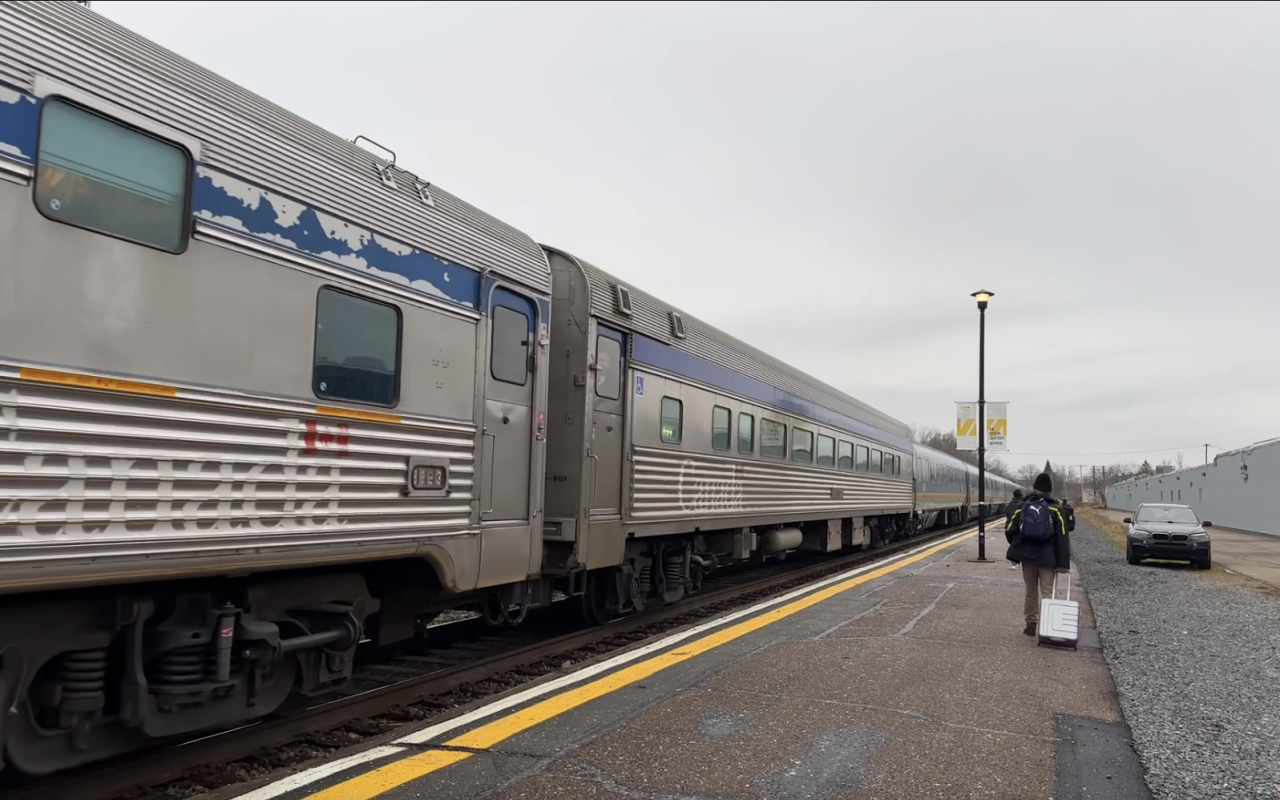
A man with a black jacket pulling a silver carry-on suitcase walks along a paved platform with his back to the camera, apparently heading to board the rather decrepit grey passenger train parked on his left, under a pale grey sky.

This article was first published by the Halifax Examiner, as the introduction to a series of three articles about passenger rail in Canada.

Just after Christmas 2023, my spouse and I boarded a VIA Rail train in Truro, Nova Scotia, bound for Montreal, with a connection to Ottawa for a family gathering. I hadn’t been on the Ocean – the train linking Halifax with Montreal – since 1998, when my family and I needed to get to Montreal for a flight to West Africa during some vicious winter weather, when highways were closed and flights cancelled.

Apart from that rail journey to Montreal a quarter century ago, and a few train trips in Cameroon, Indonesia, Kenya and Germany over the years, I have to dig way back into childhood memories to recall train travels.

The memories that surface are fond ones.

Our parents would put us kids on the train in Halifax, and we’d ride the rails to Oxford and Amherst, where our grandparents would pick us up. I am guessing our parents felt some relief as our train pulled away from the Halifax station, knowing we were safe on board, that they’d been spared the drive on what were then crowded and narrow two-lane highways, and they were in for a couple of weeks’ reprieve from loud, rambunctious children in the house.

As for us kids, we loved those train trips. They were adventures. We kept our noses to the windows, gazing at the province flashing by – as we skirted Bedford Basin, then one beautiful lake after another, and occasionally outpaced cars beside us on stretches where the tracks run parallel to Highway 2. We held our breaths (at least I did) on narrow rail bridges over deep gullies, as we moved towards and then through the magnificent Wentworth Valley.

All of which is to say, I was more than a little chuffed to be heading out on that same train track again at the end of 2023, this time as a much, much older person.

Several friends and family members asked why on earth we would opt for that long, 30.5-hour (at best) train trip to Ottawa when we could take a 1.5-hour flight from Halifax, or drive the distance in just over 13 hours, especially given that the train – with a sleeper – cost more than $1,000 per person.

I pondered that myself.

First, there’s this thing that Swedish speakers, inspired by climate champion Greta Thunberg, call “flygskam” – or “flight shame.” It’s the guilt one feels in an aircraft spewing greenhouse gas emissions into the atmosphere in the midst of the climate emergency. According to the European Union, “if global aviation were a country, it would rank in the top 10 emitters.”

In contrast, rail transport, is among “the most energy-efficient and lowest-emitting transport modes,” according to the International Energy Agency. So that appealed to me, even if I would learn later that this applies to modern and efficient trains carrying lots of passengers, and not necessarily to Canada’s antiquated long-distance diesel-powered trains.

In addition to the climate considerations, I also just don’t like flying any more. Maybe it’s my age, but for whatever reason I am increasingly fearful in the air, suspicious about the safety of the aircraft, ever more impatient with long security line-ups and body scanners and searches.

Third, I am wary – even terrified – of winter driving, especially in blizzards, and I’ve white-knuckled my way through too many of those. Nor do we have a car I really trust to get us to Ottawa without a problem.

So, for the first time in a very long time, I chose the train. I’m glad we did.

It was a back-to-the-future experience – in the same train cars I suspect I rode as a kid. I was bowled over by the courteous service from the VIA Rail crew on-board (and also the VIA reservation agents I spoke to on the phone when I booked the trip) that reminded me of a time – decades ago – before neo-liberalism took over. Back before so many public corporations and services were privatized, before passengers somehow became “customers,” and everything from support service to cleaning was outsourced to the lowest bidder, often the cheapest, most exploitive employer. The VIA Rail employees seemed genuinely happy to be looking after passengers, which they did as consummate and caring professionals.

But we hadn’t even boarded the Ocean in Truro when we started to hear horror tales about it. A security person on the platform decided that for some reason known only to him, it would be a good idea to tell a bunch of passengers that the train was always late, and had been known to back up all the way from New Brunswick when locomotives stopped working, and about a recent accident at a crossing that meant passengers had to take a bus. This didn’t sound promising at all.

And no amount of good food and good service from friendly VIA Rail staff could mask the reality that the Ocean is plagued by problems.

There were long delays on the rails, a long stretch of poor tracks in northern New Brunswick where the online VIA trip tracker informed us we were mostly going 23 kilometres an hour, and I wondered how sound those ancient train cars could really be. When I asked some of the VIA crew members about the state of the tracks and the trains themselves, which seemed not to have changed in half a century, they hinted at enormous risks facing passenger rail in our country.

Related: Federal transport plan fails to give VIA what it needs to succeed

This raised so many questions. How had we gone from a country that ostensibly existed only because of its transcontinental railway – at least that was the myth perpetuated in songs like Gordon Lightfoot’s “Canadian Railroad Trilogy” – to not having a single passenger train that crossed from one coast to another? Why was Canadian National sold off in 1995? And why was VIA Rail created in 1977 as a Crown corporation? Why did VIA Rail trains that transported people have to yield to Canadian National and Canadian Pacific freight trains? When and how had passenger train service in Canada become so diminished, and what are the prospects for VIA Rail and affordable public passenger rail transport in Canada? When other countries around the world are busy developing and expanding high-speed publicly-funded rail networks, why are Canada’s passenger trains so few, so old, and so damn slow?

Ultra-modern white electric train locomotive with headlights on at modern train platform, and the silhouette of a man wearing train conductor uniform standing on the platform beside the train. Credit: Rikku Sama on Unsplash

Modern high-speed electric train at a station in Japan. Credit: Rikku Sama on Unsplash

Back home in Nova Scotia, I set out to find people who could answer some of those questions.

A series of articles that looks at the past, present and future of Atlantic Canada’s and national passenger rail service is the result of those conversations.

The first in the series looks at the state of passenger rail in Nova Scotia and VIA Rail’s train that runs between Montreal and Halifax.

Read more

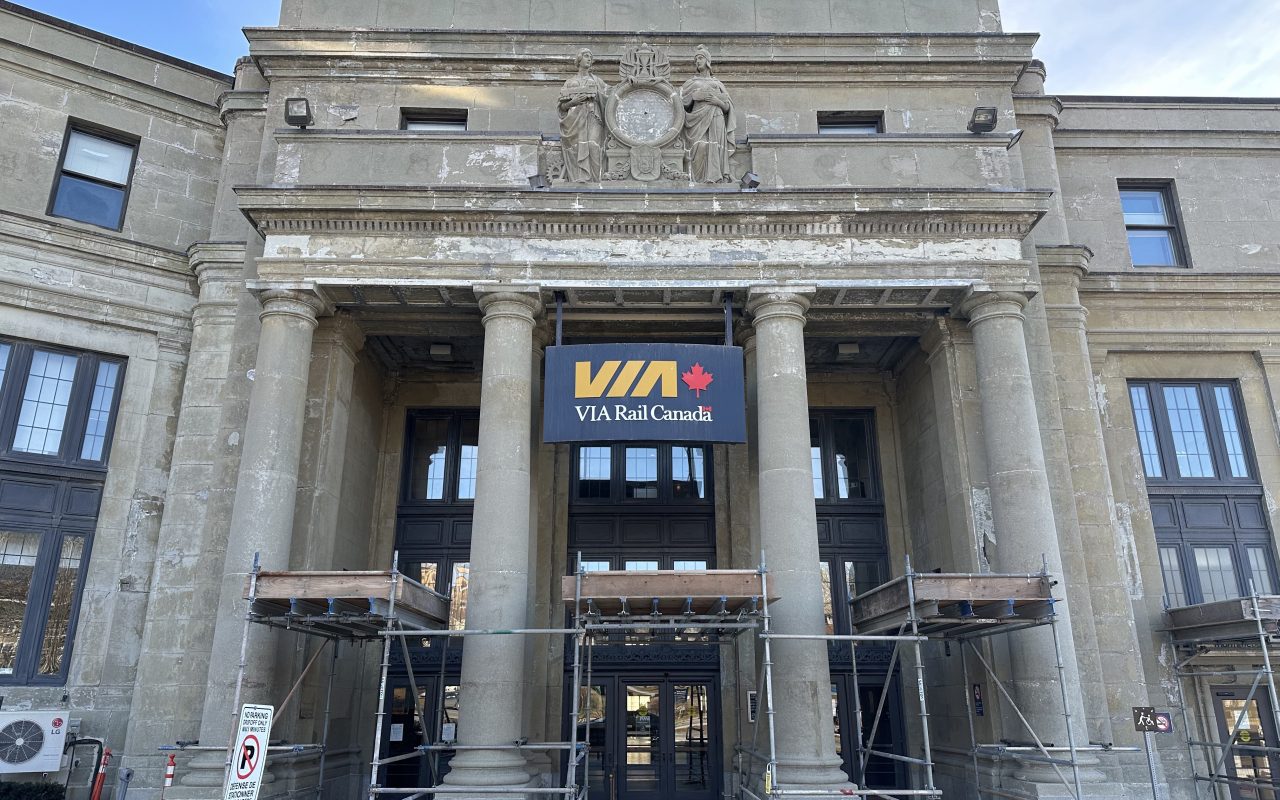
Grandiose facade of a concrete building, with pillars and empty place where a clock may once have been. The sign "VIA Rail Canada" with the yellow logo and red maple leaf is suspended between two columns, and construction is ongoing, as scaffolding is in place between the columns. Credit: Joan Baxter

This article, the first of a three-part series on passenger rail in Canada, was originally published by the Halifax Examiner. The introduction is here.

It’s a Friday morning, which means the Ocean – VIA Rail’s thrice-weekly passenger train to Montreal – is sitting on the tracks at the VIA station in Halifax, almost ready for boarding.

But I’m not here today to take the train; I’m here to talk trains with Tim Hayman.

Hayman is a board member of the citizen transportation advocacy group Transport Action Canada and president of its regional chapter, Transport Action Atlantic. He’s met me in the elegant and spacious VIA Rail station, a grandiose hall adjoining the once-grand Nova Scotian Hotel, now owned by Westin.

Both were built by Canadian National Railways in the late 1920s. CNR (now CN) was founded as a Crown corporation in 1919, bringing under one roof several railways previously owned by the government, and others the government acquired after they went bankrupt.

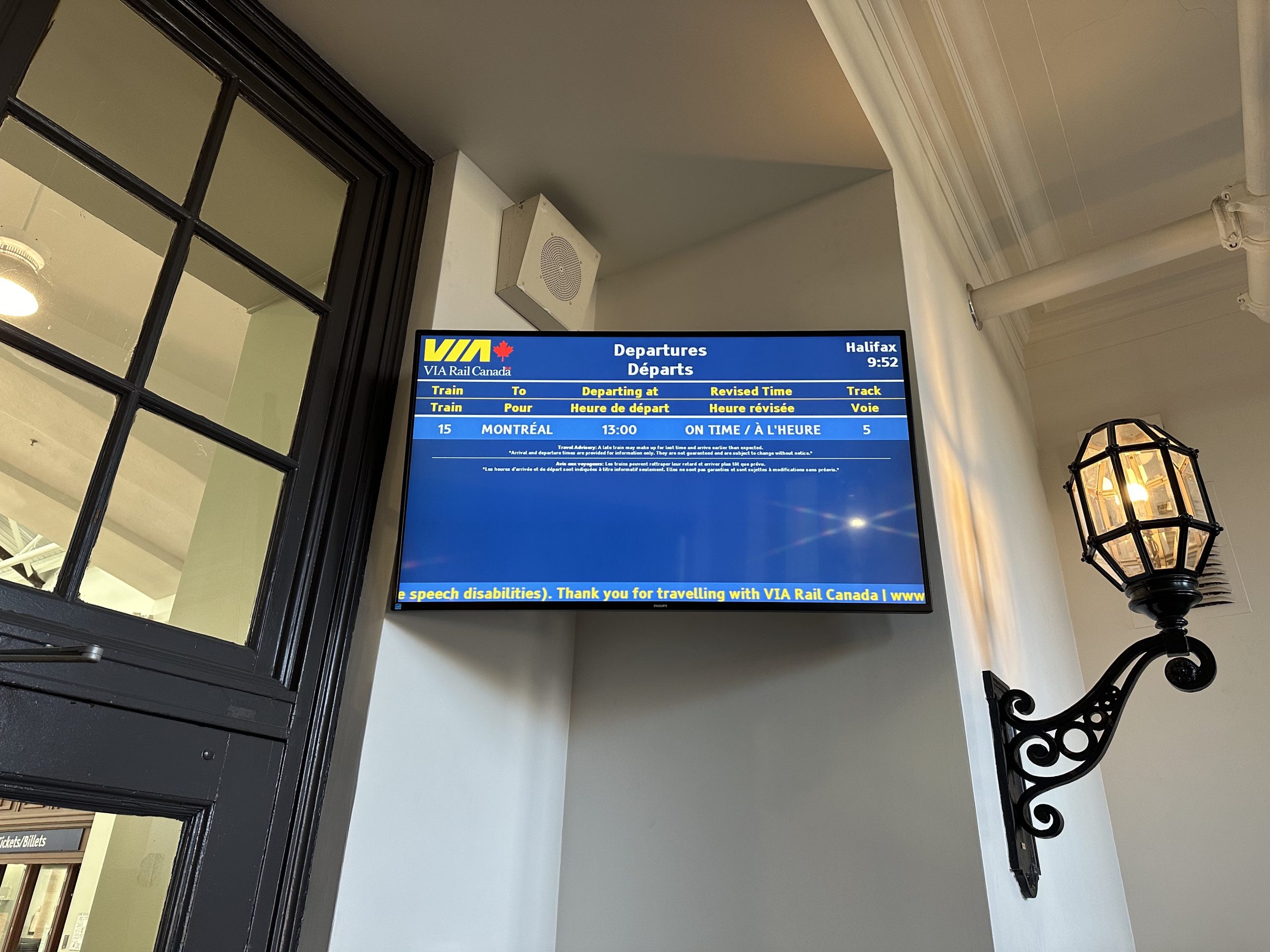
As Hayman and I speak, passengers trickle in with their luggage, ready to board the Ocean, scheduled to depart for Montreal at 1pm

A blue screen mounted in the upper corner of a building, flanked by a stylized old-fashioned lamp on the right, and upper casement doors windows on the left, showing Departures for VIA Rail trains from Halifax, namely a single train to Montreal at 13 hours, shown "on time"

At the Halifax VIA Rail station, three times a week the departure screen shows the Ocean train leaving for Montreal at 13h. Credit: Joan Baxter

Hayman tells me he wishes he were getting on the train, as he always does, no matter how many times he’s made the Ocean journey over the years.

And he’s made it a lot.

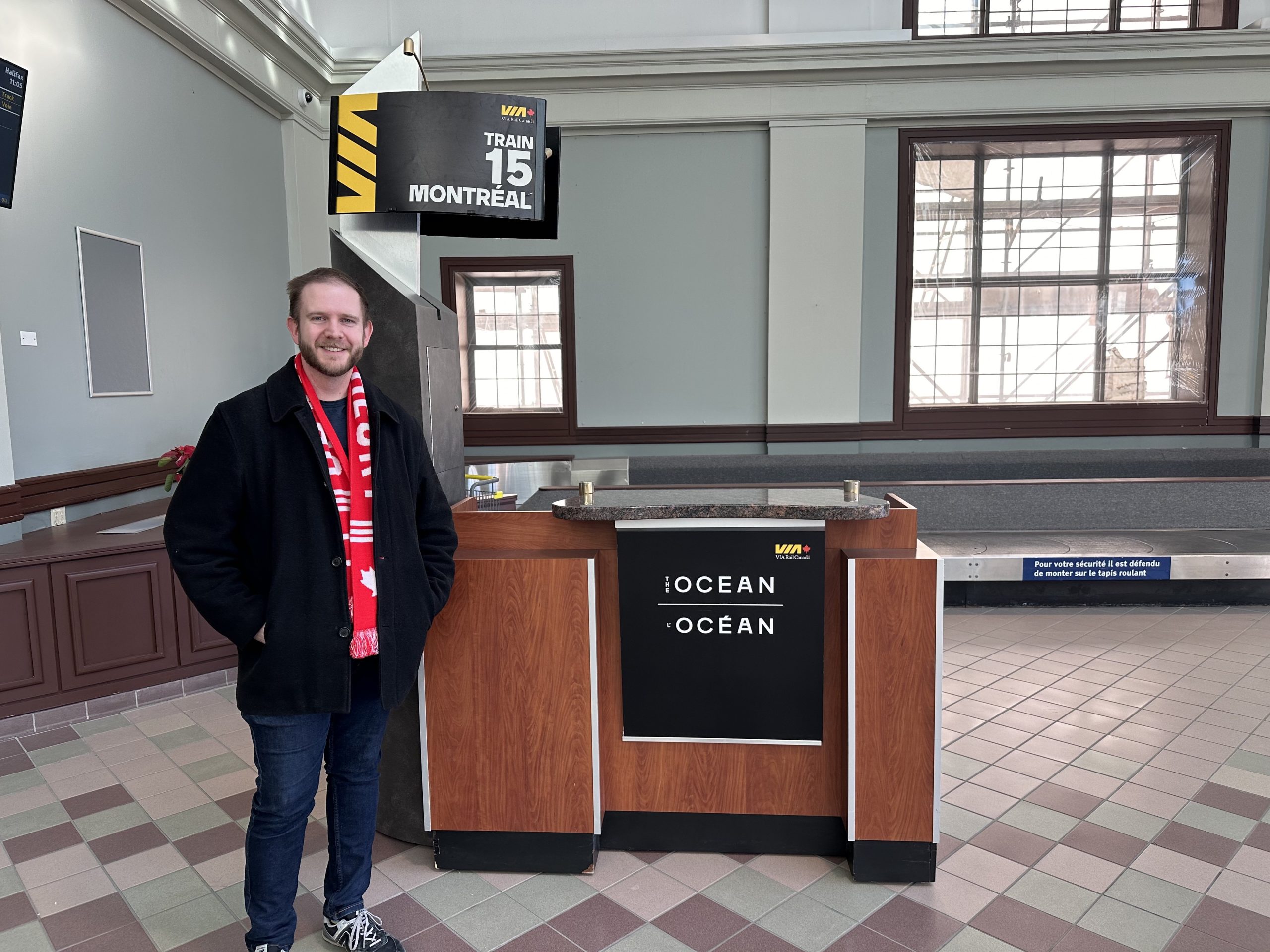
A smiling man with short dark hair, wearing a black thigh-length jacket and a red and white scarf, blue jeans and sneakers, stands with his hands in his jacket pockets in front of a wooden desk with the words "The Ocean" on it, and underneath an overhead sign saying "VIA Train 15, Montréal.

Tim Hayman at the Ocean departure gate in Halifax VIA Rail station. Credit: Joan Baxter

Hayman documents his many trips in a colourful and fascinating “Tim’s train travels” blog that tells tales – some of them harrowing – about the ups and downs, the joys and also the woes, the delays and major disruptions that are part of the experience of travelling a train as antiquated as the Ocean, and running on tracks where VIA trains have to cede priority to massive freight trains owned by CN, which owns the tracks.

Even with all the pitfalls Hayman details in his blog, he loves the Ocean.

And he is happy to count the ways.

Read more