Canada

There’s a 21st century gold rush starting in Nova Scotia on Canada’s Atlantic coast, just as industrial gold mining is increasingly coming into disrepute around the world. It has been described as an “environmental disaster,” which often leads to contamination of water sources on which life depends. This is the second in a series of four articles on mining and quarrying in Nova Scotia. Earlier versions of these articles appeared in May and June 2018 in the Halifax Examiner and the Cape Breton Spectator. (I am pleased to say that this series of four articles has been shortlisted for an Atlantic Journalism Award in Excellence in Digital Journalism: Enterprise/Longform.)

Part 2. Going for gold

Screenshot of BNN interview of Atlantic Gold CEO Steven Dean (left) at the 2018 Prospectors and Developers Association of Canada (PDAC) convention.

The CEO and chairman of Vancouver-based Atlantic Gold Corporation, Steven Dean, a man with a history of international coal and metal mining and former president of Teck Cominco, was being interviewed by Andrew Bell of the Business News Network (BNN).[1] Dean was talking up his company’s first gold mine, named Touquoy after a French miner who worked the deposit in the late 1800s, which had just gone into production in Moose River, Nova Scotia.

The interview was held at an ideal venue for Atlantic Gold to showcase its new open-pit gold mine, the first ever in Nova Scotia: the 2018 convention of the Prospectors and Developers Association (PDAC) of Canada in Toronto, the global mining industry’s “event of choice.”

Bell expressed amazement at the low cost – $550 – of producing an ounce of gold at the Touquoy mine. Dean told him the mine would produce about 90,000 ounces a year which, at current gold prices, would make it a “profitable mine” with about $90 million in “operating cash flow.” And, said Dean, Atlantic Gold planned to enter its second phase of operations by 2022, with more mines operating in the area, producing a total of 200,000 ounces a year.

Read more

There’s a 21st century gold rush starting in Nova Scotia on Canada’s Atlantic coast, just as industrial gold mining is increasingly coming into disrepute around the world. It has been described as an “environmental disaster,” which often leads to contamination of water sources on which life depends. This is the first in a series of four articles on mining and quarrying in Nova Scotia. Earlier versions of these articles appeared in May and June 2018 in the Halifax Examiner and the Cape Breton Spectator. (I am pleased to say that this series of four articles has been shortlisted for an Atlantic Journalism Award in Excellence in Digital Journalism: Enterprise/Longform.)

Part 1. Welcome to the gold rush

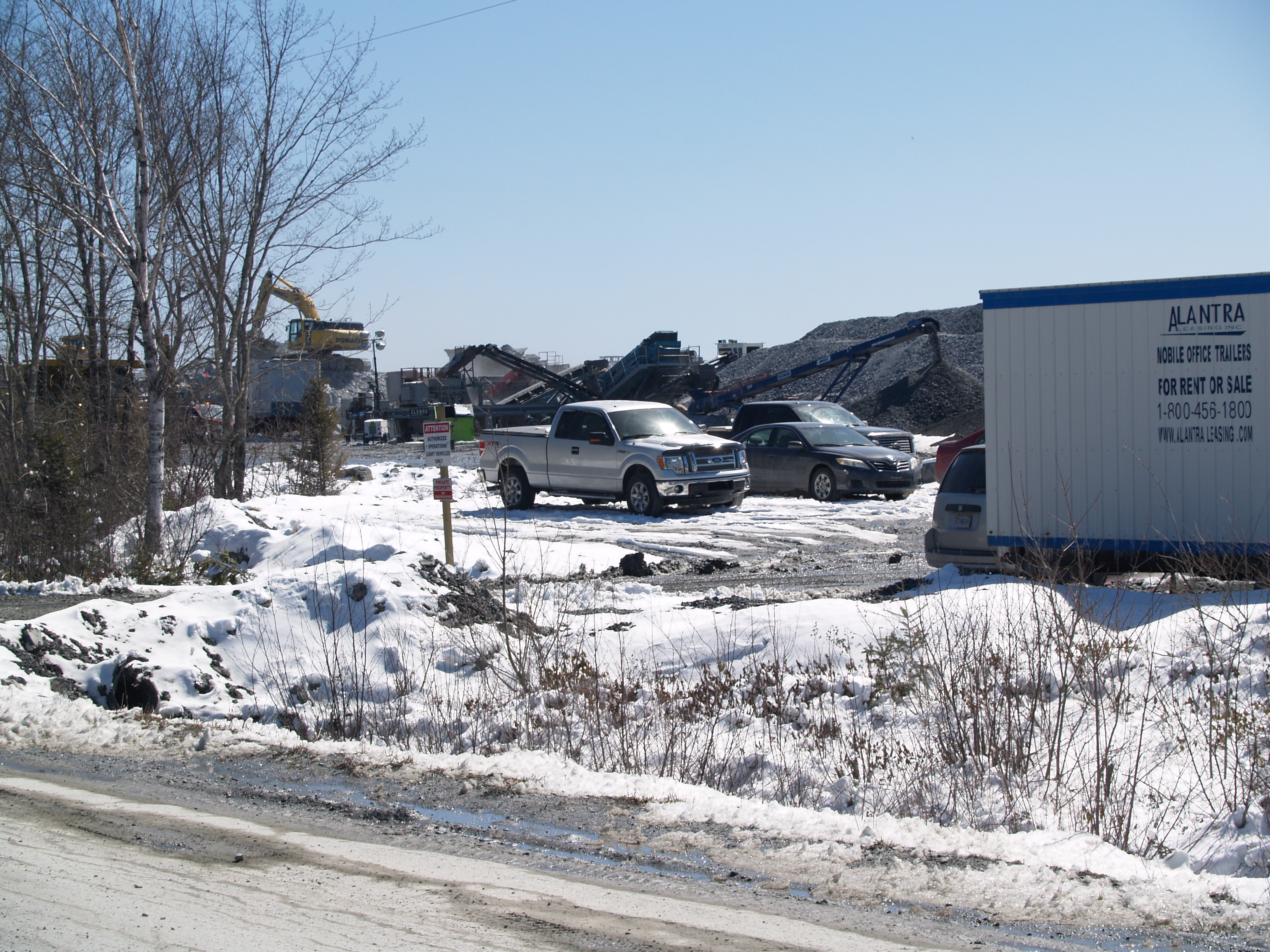
Atlantic Gold’s open pit gold mine in Moose River, Nova Scotia, one of four the company has planned, and one of six proposed for the province’s Eastern Shore. Photo: Joan Baxter

In October 2017, Vancouver-based Atlantic Gold opened Nova Scotia’s very first open pit gold mine, one of four it has planned for the province. The Touquoy mine, about 100 kilometres from Halifax, is named after French miner Damas Touquoy, who first worked the Moose River deposit back in the late 1800s.[1]

Officiating at the opening ceremony, and energetically applauding the cutting of the ribbon, was Nova Scotia’s Minister of Transport and Infrastructure Renewal, Lloyd Hines.

Years earlier, Premier Darrell Dexter’s NDP government in the province gave the mine a helping hand when then minister of natural resources, Charlie Parker, issued a vesting order allowing the mining company to expropriate land that had been in the Higgins family for 120 years.

It looks as if Nova Scotia, where small-scale, underground gold mining persisted from the mid-1800s until the 1940s, is once again pinning a good part of its future on gold.

Read more

The pulp mill in northern Nova Scotia. Photo by Dr. Gerry Farrell

By Joan Baxter

December 12, 2017 (updated November 29, 2022)

When I held the first copy of “The Mill – Fifty Years of Pulp and Protest” in my hands five years ago, in November 2017, all I thought is: “I told the story. That is done. On to other subjects and issues now.”

Ha. Little did I know. The Northern Pulp / Paper Excellence saga had just begun … for me. Others already knew what kind of corporation this was. I had no idea. Not then.

Right to left: Acclaimed ward-winning songwriter and musician Dave Gunning who inspired the book, the incredible person, activist and actor Elliott Page, myself, and Lil MacPherson, climate activist and co-owner of the Wooden Monkey restaurants, who passed “The Mill” on to her friend, Elliot Page, to read.

The book and its birth – a short history

So, a breath here, because I need to go back to the beginning.

In early June 2016 I had just returned home to Nova Scotia after several years of working in Nairobi, Kenya, as a science writer and communications specialist for international agricultural research organizations. My aim once home was to get back into journalism, or to try my hand again at book-writing – I’d already authored a book of short fiction and four books of non-fiction.

But then one morning the stench of the 49-year-old Northern Pulp mill in Pictou wended its way overland 40 kilometres to my house in northern Nova Scotia, giving me a blinding headache and a nosebleed. That led to a few hours of googling, which led to two phone calls. One was with the environmental expert at Northern Pulp, who told me that if I was smelling the mill that day, it merely meant the wind was blowing my way. The second was with Dave Gunning,  award-winning songwriter and musician, and also a “factivist” who was part of a group called “Clean the Pictou County Pulp Mill,” asking that the mill be forced to clean up its act, stop suffocating Pictou County in toxic emissions.

By the end of the day, I had decided there was a book to be written about this pulp mill that had opened in the 1960s.

I started from scratch to look into the history of the mill, and scratching turned into digging. Deep digging. My original plan to do a historical account of the mill’s birth and lifetime in Nova Scotia was foiled by the refusal of the mill owner – Paper Excellence – to grant me an interview or a tour of the facility.

Eight months into the research, and after repeated requests, in January 2017, then-communications director for Paper Excellence, Kathy Cloutier, wrote to inform me that, “Upon discussion within Paper Excellence, Northern Pulp executive team and board members the decision has been made that Northern Pulp will not participate in this project.”

I’d been working for months on the project, and I had no intention of stopping. The material I uncovered was fascinating, and sometimes shocking.

Still, there were times – late at night – that I lay awake questioning the wisdom of spending more than a year researching and writing a book about a pulp mill in a small town in a small province in eastern Canada. It was an intense (and income-less) time.

Not that it wasn’t a fascinating and fulfilling journey of learning. It was that, and more.

It was a great pleasure and privilege to meet and listen to so many interesting, informed and passionate people who had been involved in one way or another with the mill over the years. Some had family members working there or had worked for the mill themselves at one point. Their views on the mill were nuanced. On one hand, it provided jobs and supported a lot of service industries in the area and forestry contractors around the province. If it smelled, so be it – that was just the smell of money.

But others felt the county had paid too high a price for the big smelly mill. Over the five decades that it had been in operation, one group of citizens after another had come together to create waves of protest, to try to get one government after another to do its job and protect them from the harmful effects of a large industry.

Read more

Cover photo by Dr. Gerry Farrell

This book explores the power that a single industry can wield over an entire province, namely Nova Scotia in eastern Canada. It is a story that has been waiting to be told. With a powerful foreword by Elizabeth May, leader of Canada’s Green Party and Member of Parliament for Saanich-Gulf Islands, British Columbia, it has local, national and even global relevance.

November 2017

Fifty years ago this month a long list of dignitaries and politicians gathered at Abercrombie Point in Pictou County, northern Nova Scotia, for the official luncheon and opening of the brand new pulp mill owned by Scott Paper of Philadelphia.

Since it went into operation in 1967, the mill has provided valuable jobs and found support from governments of all levels and all stripes. But it has also fomented protest and created deep divisions and tensions in northern Nova Scotia.

Twelve premiers and five foreign corporate owners later, the mill remains a smelly fixture across the harbour from the picturesque waterfront of Pictou, the birthplace of New Scotland.

Its fascinating story is one that has been waiting to be pieced together and told. And that is what Nova Scotian journalist and award-winning author Joan Baxter does in the new book The Mill: Fifty Years of Pulp and Protest.

Picturesque Pictou waterfront across from the pulp mill. Photo by Joan Baxter

It meticulously and dispassionately documents the history of the Pictou County mill using archival material, government records, consultant and media reports, and poignant interviews with people whose lives have touched by the mill and the pulp industry. By weaving these personal stories into the historical narrative, the book brings to life five decades of controversy and citizen-led campaigns to have the mill clean up its act, and to have government protect the people and environment rather than lavishing hundreds of millions of dollars of financing and other concessions on a mill owned by large corporations.

Boat Harbour in June 2016. Photo by Joan Baxter

This book takes readers to Pictou Landing to hear from members of the First Nation there, and learn about their betrayal by both provincial and federal governments, which turned Boat Harbour – so precious to them that they called it “the other room” (A’se’K in the Mi’kmaq language) – into a stinking, toxic wasteland. It gives voice to people whose well-being, health, homes, water, air, businesses have been affected by the mill’s effluent and emissions, and to people whose livelihoods have depended on the pulp mill.

This compelling book is a rich tapestry of story-telling, of great interest to everyone who is concerned about how we can start to renegotiate the relationship between the economy, jobs, and profits on one hand, and human well-being, health, and a healthy environment on the other.

The Mill tells a local story with global relevance and appeal. It is a story of corporate capture of governments and regulatory agencies that citizens have been protesting and struggling to reverse for the last half century … and even longer.

About the author: Joan Baxter is a journalist, science writer, anthropologist and an award-winning author. She has written seven books, authored many media and research reports on international development and foreign investment, and reported for the BBC World Service and contributed to many other media, including the CBC, Le Monde Diplomatique, Toronto Star, The Globe and Mail, The Chronicle Herald, The Coast.

In the media …

CTV Live At Five, November 27, 2017, Host Kelly Linehan interviews Joan Baxter about “The Mill – Fifty Years of Pulp and Protest.”

The News (New Glasgow), November 23, 2017, “Author releases book offering critical look at pulp mill,”by Sam MacDonald

If there was anyone who didn’t agree with Baxter and her position, they did not speak up that night. The Tuesday evening event had an air of utter solidarity, with singer and activist Dave Gunning, a member of the Clean the Mill Group, opening with music that was a propos to the theme of the book.
Baxter admitted she was surprised that nobody spoke out against her writing and assertions, saying, “I was talking to a friendly audience and I was a little surprised that I didn’t hear any differing opinions.
“I understand that this can be a sensitive topic – livelihoods depend on the mill. I would have been happy to engage people, if they read the book.”

Author interviewed on The Rick Howe Show, News 95.7, Halifax, Nova Scotia November 23, 2017, 9 – 10 AM, at 39 minutes 42 seconds

“The Mill – Fifty Years of Pulp and Protest” is available in selected bookstores, and also online at:

Chapters Indigo

Nimbus Publishing

Amazon

 For more information / media inquiries:

Joan Baxter: Themillthebook@gmail.com, dev.joanbaxter.ca

Lesley Choyce, Pottersfield Press: lchoyce@ns.sympatico

Upcoming events

Author book signing “The Mill: Fifty Years of Pulp and Protest”, Saturday, November 25, 2017: 12 noon – 1:30 PM, Indigo Chapters bookstore, 41 Mic Mac Boulevard, Dartmouth, Nova Scotia

Author book signing “The Mill: Fifty Years of Pulp and Protest”, Saturday, December 2, 2017: 12 noon – 1:30 PM, Coles Bookstore, Truro Mall, 245 Robie St, Truro, Nova Scotia

Author book signing “The Mill: Fifty Years of Pulp and Protest”, Saturday, December 2, 2017: 3 – 4:30 PM, Coles Bookstore, Highland Square Mall, 689 Westville Rd, New Glasgow, Nova Scotia (This event will not take place on December 2, 2017 … if it is rescheduled, I will keep you posted!)

 

Read more

By Joan Baxter

stop-harper (1)It was bad enough watching Canada’s Immigration Minister Chris Alexander on CBC’s Power and Politics lying to Rosemary Barton, telling her that the media are to blame for the country’s pathetic response to the refugee crisis.

And it certainly wasn’t any easier listening to Alexander stonewall As It Happens’ Carol Off when she asked, repeatedly, how many of the 200 government-sponsored refugees from Syria had actually made it to Canada by June 2014. That was before he hung up on her, claiming later he’d been late for Question Period.

It was equally galling reading Alexander’s nasty attack on the Ontario government after it reinstated health care to all asylum seekers after the Harper Government stripped it away. And his dangerous, preposterous comment that this would make Canada “a magnet for bogus asylum seekers” raised questions about just how low Harper’s government could and would stoop.

But nothing — absolutely nothing — could possibly be as distressing as that soul-searing, heart-wrenching photo of three-year-old Aylan Kurdi dead on a Turkish beach and the awful fact that Aylan and his family might have been granted asylum in Canada long before they got on that boat. Earlier this year, the NDP Member of Parliament for Port Moody – Coquitlam, Fin Donnelly, hand-delivered to Chris Alexander a letter in support of the privately sponsored refugee application for some of the Kurdi family to join their relatives in British Columbia. Citizenship and Immigration Canada now says no application for Aylan’s immediate family was ever received.

Regardless, it’s too late. Aylan Kurdi, his mother and his brother are now dead, like another 6,000 refugees and migrants who have perished or disappeared en route to Europe since January 2014.

There is much blame to go around in this horrendous refugee crisis. But the blame for how poorly Canada has responded lands squarely on the shoulders of the Harper Government with its rhetoric about “bogus refugees”.

Read more

BY Joan Baxter

“The earth, our home, is beginning to look more and more like an immense pile of filth.” This hard truth comes from a 183-page document that makes a plea for our species to come to our senses and hear “the cry of the earth and the cry of the poor”.

It’s a powerful cri de coeur for humankind to stop the plunder of the planet, confront climate change and end unfettered capitalism that is driving the destruction and disparity between rich and poor. It continues: “Many of those who possess more resources and economic or political power seem mostly to be concerned with masking the problems or concealing their symptoms, simply making efforts to reduce some of the negative impacts of climate change.”

Strong words, revolutionary even. The kind of language one might expect from the environmental or social justice groups often labelled “radical” or “extremist” by the powerful elites these statements condemn.

But they’re not. They come from the Encyclical written by Pope Francis, arguably the single most influential man on the planet as spiritual leader of 1.2 billion Catholics around the world.

Read more