Canada

Concrete facade of an imposing building, looking a little worse for wear, with a Canadian flag flying to the left of the columns and entrance to the building, over which there is a blue sign with the yellow logo of VIA Rail and its red maple leaf.

This, the third and final article looking at passenger rail service in Canada, was originally published by the Halifax Examiner. It delves into the decision by the federal government to privatize the most lucrative VIA Rail route in Ontario and Quebec, and what this could mean for passenger rail service in the rest of the country. The first two articles are available here and here .

On March 9, 2022, Omar Alghabra, then Canada’s transport minister, announced that the federal government was about to privatize the country’s busiest passenger rail corridor between Windsor, Ontario, and Quebec City.

Of course that is not quite the way Transport Canada worded the surprise announcement in its press release full of doublespeak, under this deceptively benign headline: “Government of Canada launches the next phase in the procurement process of High Frequency Rail.”

The word “privatize” is nowhere to be found in the press release, even though it clearly states that the government of Canada was launching a “Request for Expressions of Interest” from “industry” on the High Frequency Rail (HFR) project, to allow the government to “seek feedback from experienced private sector companies to help shape” the HFR project.

Almost as an afterthought, towards the end of the press release, Transport Canada gets around to mentioning the Crown corporation, VIA Rail, and its employees, which it says “are central to the success of High Frequency Rail and will continue to play a key role across Canada as our national passenger rail provider.”

That March 2022 announcement made one thing very clear: the plans for the future of VIA Rail’s passenger rail service had changed.

Not just changed, but really changed.

Instead of simply moving ahead with the “High Frequency Rail project” in VIA Rail’s Windsor-Quebec City corridor, which would “offer a faster, more frequent, accessible and sustainable rail service,” the federal government was now planning to privatize that chunk of the VIA Rail passenger service.

The high frequency rail project – not to be confused with high speed rail (HSR) for which there are no plans in Canada – had been in the works since VIA Rail first proposed it in 2016. It would involve some new tracks exclusively for VIA Rail’s use and improved tracks elsewhere to allow passenger trains to move at good speeds without ceding way to CN freight trains. It would also include new trains for that corridor.

In addition, VIA Rail had been hoping for federal funding so it could replace its antiquated equipment on its long-distance routes – the Ocean train between Montreal and Halifax, and the Canadian between Toronto and Vancouver.

All of this – the HFR project and the new equipment for long-distance trains – would be managed by VIA Rail, greatly improving its passenger rail service and securing its future as a crucial public service.

At least that had been the plan before March 2022.
Read more

This article was originally published by the Halifax Examiner on November 28, 2021.

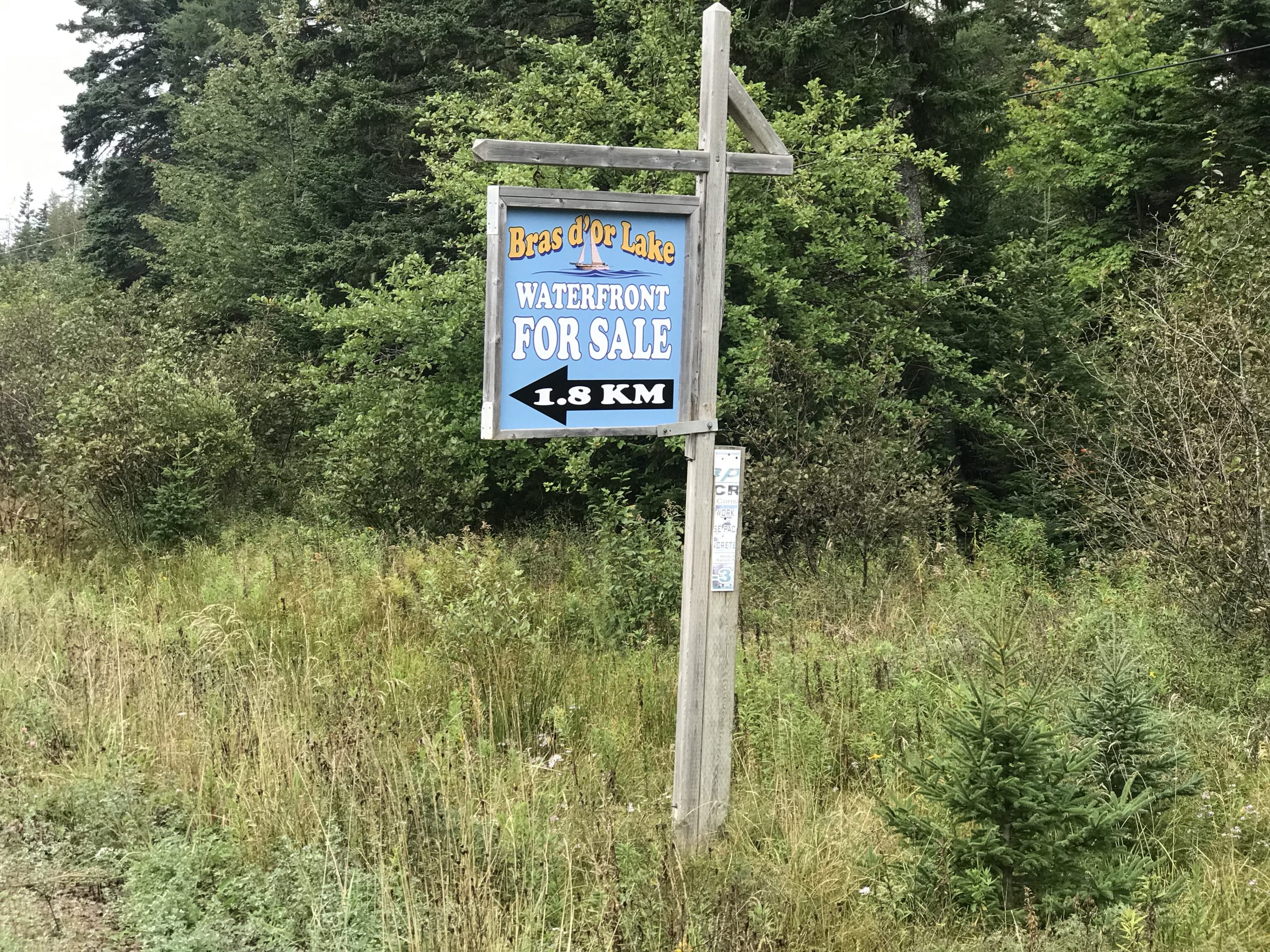
Sign on Highway 4 in Cape Breton advertising waterfront for sale on the Bras d'Or Lake. Photo by Joan Baxter

Photo: Joan Baxter

Nova Scotia has long been a popular place not just for settlers, but in the last century it also became a popular place for non-residents — including many well-heeled Americans and Europeans — to purchase properties.[1]

For decades, scholars and successive governments have debated the issue of non-resident land ownership in a province with relatively little Crown land, with waterfronts being carved up into private properties that reduce public access to Nova Scotia shorelines.

The COVID-19 pandemic has caused a real estate boom in Nova Scotia, including most rural counties, as people from urban centres, elsewhere in Canada and abroad, looked for ways to escape crowded urban areas.

A few months into the pandemic, the German magazine, Der Spiegel, broke the story that some right-wing conspiracy theorists were marketing Cape Breton to like-minded German-speaking Europeans, which added yet another dimension to long-standing questions about non-resident land ownership in Nova Scotia.

This three-part series follows up on its 2020 coverage and looks into some of these questions it raises, even as the province prepares to change the property tax rate for non-resident owners.

This, the final of three articles, looks at previous efforts to come to grips with the question of land ownership regulation in Nova Scotia, what it means for affordability of properties, and why it’s all been so contentious for so long.

Read part 1 here.

Read part 2 here.

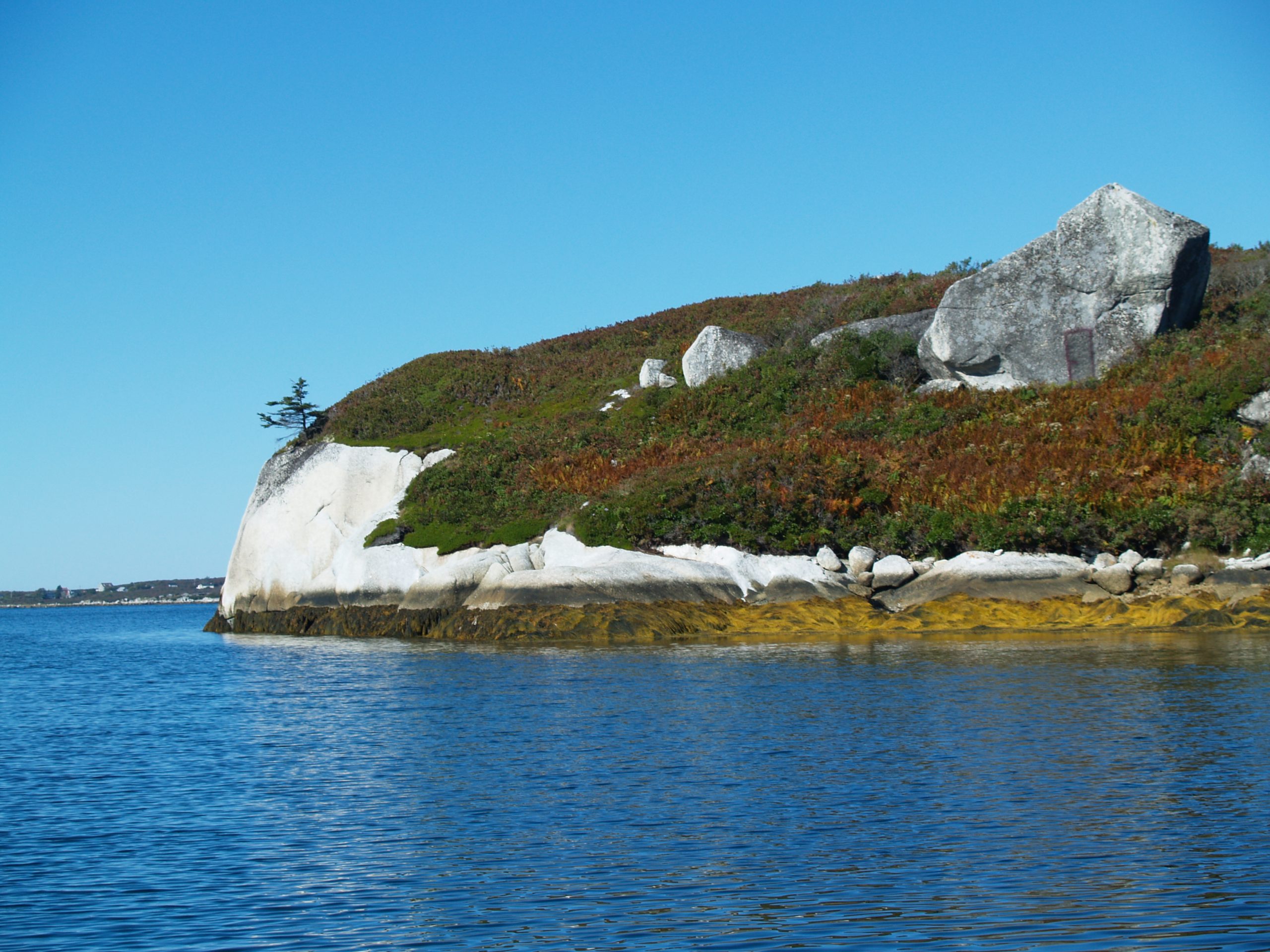
Stunning white rock shoreline near Terence Bay. Photo by Joan Baxter

Nova Scotia coastline near Terence Bay. Photo: Joan Baxter

It was a spring day, and as they’d been doing for some weeks, Jan and Paul (not their real names) were driving around looking for land on the South Shore of Nova Scotia, where Jan had spent a good part of her childhood.

Both were living and working in Halifax, and wanted a property they could call their own, where they would settle down and eventually retire. They had been scouting out properties for weeks, and had yet to find a place they could afford. For many years, the South Shore had been popular with American and European buyers who had no problem paying hefty prices for oceanfront properties.

“One day we were driving out near Terence Bay,” Jan recalled for the Halifax Examiner. “And we saw this sign that said ‘lots for sale’ on a dirt road that seemed to lead to the waterfront. So we just started driving. The gate was open.”

Suddenly another vehicle came out of nowhere and cut them off. The woman driver stopped her car, slammed the door, and approached their open window, angrily informing them they were on private property.

“We said we were sorry but that we had seen a sign that there were lots for sale, and we told her we were potential buyers,” Jan said.

The woman, who had a strong German accent, was still angry, and proclaimed loudly, “We don’t sell to Canadians.”

She said the lots were only for Europeans.

Jan and Paul turned around and headed back to the main road.

Jan, a fifth generation Nova Scotian, was in tears.

This happened back in the mid-1990s, but Jan remembers it as if it were yesterday, especially her visceral reaction to being told that Canadians were not welcome to buy land in … Nova Scotia.

A new tax levy for non-residents?

Non-resident land ownership in Nova Scotia has been a contentious issue for decades.

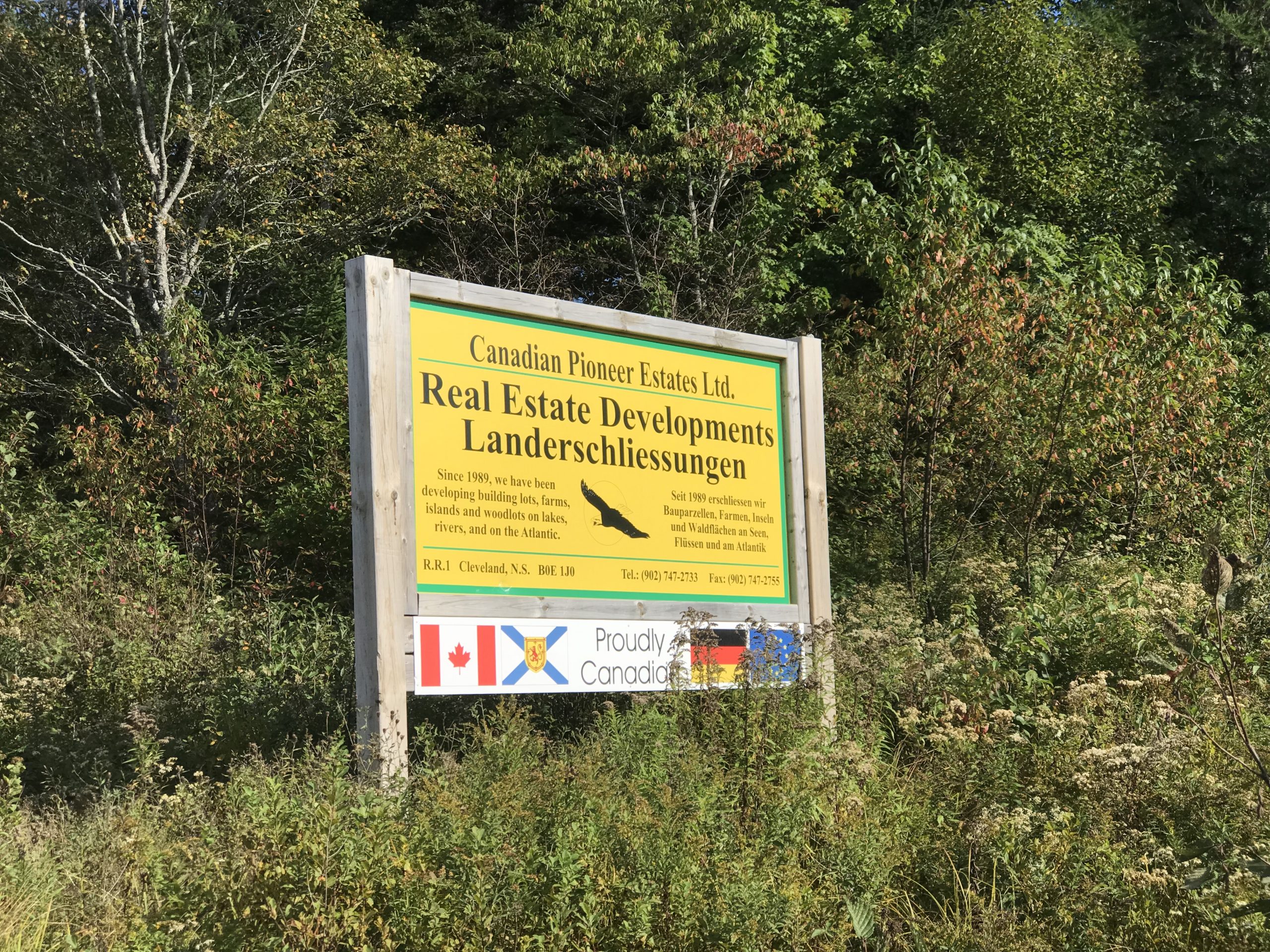
Canadian Pioneer Estates billboard in Richmond County, Cape Breton. Photo by Joan Baxter

Canadian Pioneer Estates sign in Richmond County, Cape Breton. Photo: Joan Baxter

The question of whether those who own land, reside and pay taxes in Nova Scotia should pay lower property taxes than those who do not has been debated, discussed, and disagreed on since the 1960s.

Read more

This article was originally published by the Halifax Examiner on November 23, 2021. Note that since it was first published, Frank Eckhardt who is featured in this article, has been arrested twice in Cape Breton, once on extortion charges, and a second time for a slew of firearms offences.

Sign on Highway 4 in Cape Breton advertising waterfront for sale on the Bras d'Or Lake. Photo by Joan Baxter

Photo: Joan Baxter

Nova Scotia has long been a popular place for settlers, but in the last century it also became a popular place for non-residents — including many well-heeled Americans and Europeans — to purchase properties.[1]

For decades, scholars and successive governments have debated the issue of non-resident land ownership in a province with relatively little Crown land, and waterfronts being carved up into private properties that reduce public access to Nova Scotia shorelines.

The COVID-19 pandemic has caused a real estate boom in Nova Scotia, including most rural counties, as people from urban centres, elsewhere in Canada and abroad, looked for ways to escape crowded areas.

A few months into the pandemic, the German magazine, Der Spiegel, broke the story that some right-wing conspiracy theorists were marketing Cape Breton to like-minded German-speaking Europeans, which added yet another dimension to long-standing questions about non-resident land ownership in Nova Scotia.

In this three-part series, the Halifax Examiner follows up on its 2020 coverage of this issue, and looks into some of the complex questions it raises, even as the province prepares to change the property tax rate for non-resident owners.

Read Part 1 here.

This second article looks at more of the real estate and land development companies or individuals marketing Cape Breton Island to German speakers, and at how the trend developed.

Evans Island bridge with gate. Photo by Joan Baxter

Evans Island bridge with gate. Photo: Joan Baxter

It would be easy to miss the turn-off to the island that juts out into the Bras d’Or Lake at Hay Cove in Cape Breton.

The only indication it’s there is an innocuous sign on the edge of Highway 4 in Richmond County that advertises “waterfront” for sale. If you follow the arrow on the sign, you’ll go about a kilometer on a dirt road to a gated bridge that leads to an island.

On the island side of the bridge is a road sign that indicates that you are now on Katja Rose Drive. Just past that is a large notice that trespassing and hunting are forbidden, which advises that the island and its roads are private property.

Sign for Katja Rose Drive on Evans Island. Photo by Joan Baxter

Katja Rose Drive on Evans Island. Photo: Joan Baxter

But the “waterfront for sale” sign did seem like an invitation to visit, so it seems OK to continue along Katja Rose Drive to see what is on the market.

On either side of the gravel road are small signs fastened to trees indicating lot numbers, some with small red “sold” signs in the trees. There are also some clearings with mobile homes on them.

One lot bears a “For Sale / zu verkaufen” sign with the name and contacts for a couple in Germany. For the three-acre property, the couple are asking $96,000, the price they paid for it. There is no well or septic system on the lot, and they tell a person who recently inquired about the property that there is a high risk around the Bras d’Or Lake of drilling a well and not finding good drinking water.

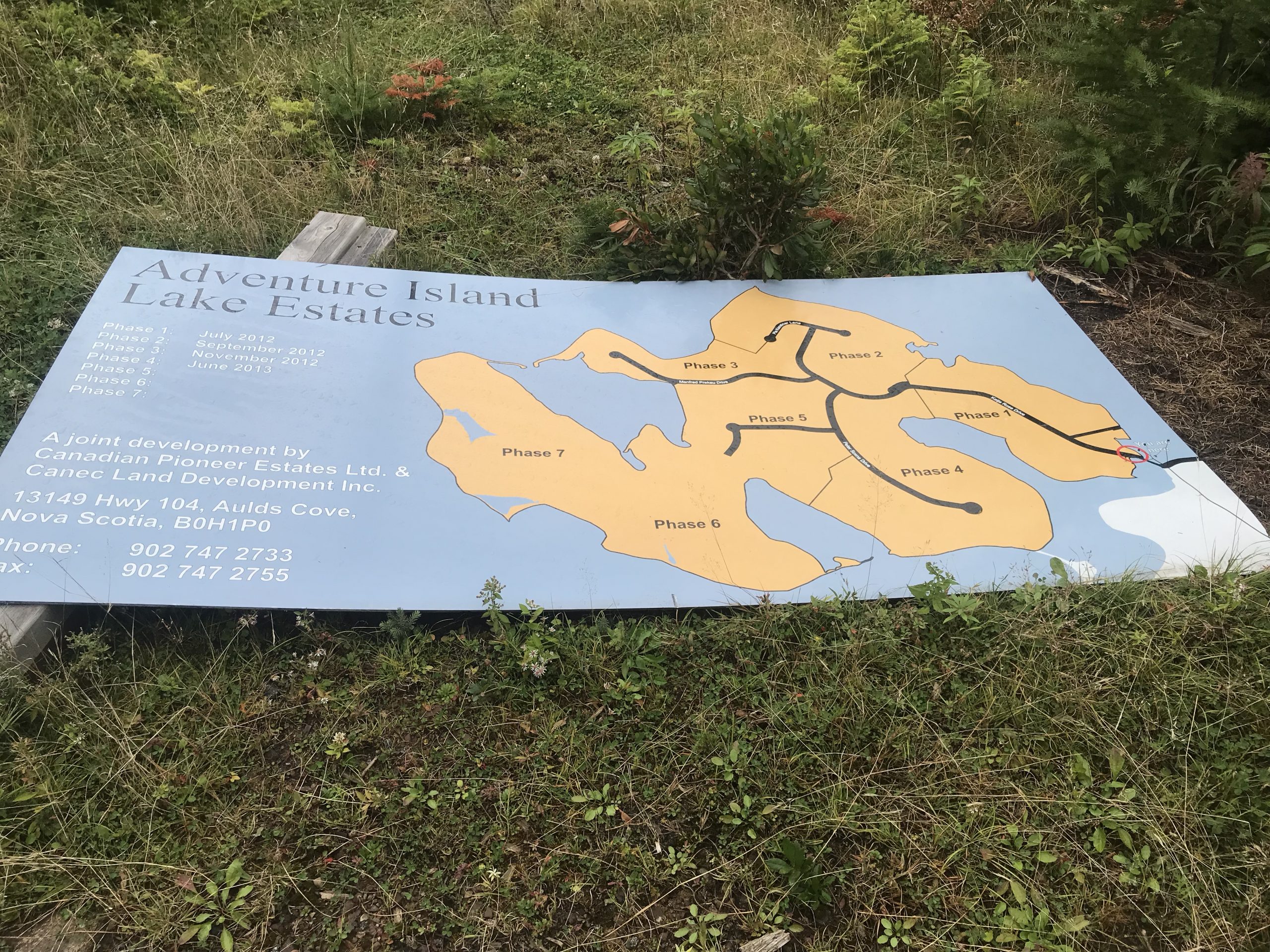
Further along Katja Rose Drive there is a large billboard that has fallen down on the side of the road, which lays out the development phases of subdivision called “Adventure Island Lake Estates,” a joint venture by Canadian Pioneer Estates and Canec Land Development Inc.

This photo shows a fallen-down signboard for the Evans Island development plan. Photo by Joan Baxter

Evans Island development plan. Photo: Joan Baxter

Welcome to Evans Island.

It has been carved into 129 lots, most about two acres, nearly all of them purchased by non-resident Germans.

Read more

This article first appeared in the Halifax Examiner on March 7, 2019. As decision-day approaches on Northern Pulp’s proposal for a new effluent treatment facility that would be constructed very close to the Canso Chemicals site, which is heavily contaminated with mercury, I decided to republish the article here.

Canso Chemicals hasn’t produced any chemicals for 29 years, but — contrary to what I wrote in the Halifax Examiner in “Northern Pulp’s environmental documents: missing mercury, a pulp mill that never was, and oodles of contradictions” — the company lives on.

Sort of.

For two decades Canso Chemicals produced chlorine for the pulping process at a site adjacent to the pulp mill on Abercrombie Point in Pictou County, but when new pulp and paper effluent regulations came into effect in 1992, the mill switched to chlorine dioxide. No longer needed, the chemical plant was closed.

A Google search for “Canso Chemicals” turns up an address (Granton Abercrombie Road, New Glasgow, NS) and a phone number, which I called. Although the Google result states that it is “permanently closed,” someone did answer the phone with the words, “Canso Chemicals.” When I introduced myself, he said he could not make any comment, but would try to find someone who could answer my questions about the company. He took my number. I haven’t had a return call.

Read more

November 18, 2019

Morila gold mine in Mali, West Africa, 2002. Photo: Joan Baxter

This book chapter is the result of a visit to the Morila gold mine in Mali nearly 18 years ago, and is excerpted from my 2010 book, “Dust from our eyes – an unblinkered look at Africa,” published by Wolsak & Wynn in Canada and worldwide by Fahamu Books, which was shortlisted for the Dayton Literary Peace Prize in 2009. I decided to republish it here because I regret to say that based on the extensive research I’ve been doing on the gold mining industry in the past few years, it looks as if not much (if anything) has improved since then. I first wrote this story for the BBC, following a visit to the Morila gold mine when it was operated by South Africa’s AngloGold and Randgold. Today, the Morila gold mine is operated by Canada’s Barrick Gold, and is a “joint venture company held by Barrick (40%), AngloGold Ashanti (40%), and the State of Mali (20%).” The economic disparities, and the environmental, social and political havoc that such gold mines cause, are all contributing factors to the horrendous insecurity that now prevails in Mali, Burkina Faso and Niger (where Canadian gold mining companies are so prevalent), causing widespread suffering – and death. If I were writing it today, I would probably entitle it, “Gold: all that glitters causes death and devastation.”

All that glitters … is taken away

… the very term investment badly distorts what’s really going on. Plundering, looting and exploiting the non-renewable resources of Africa is a far more accurate description. Gerald Caplan

In my fifth year in Mali, in late 2002, I finally obtained an invitation to accompany the country’s new minister of mines and a team of Malian journalists on a day trip from Mali’s capital Bamako to Morila, the country’s newest big gold mine.

On the short flight to the mine, I found myself seated beside a South African employee of the South African mining giant Randgold, who told me he and his wife had recently applied for Canadian citizenship and that he now lived in Toronto – when he wasn’t in Mali. He said things were deteriorating in South Africa, “if you know what I mean,” and that he and his wife, as white South Africans, felt their futures were in Canada.

He went on to tell me about the wonders I was about to experience at Morila, especially the man-made lake that was filled with water pumped 40 kilometres from a small river, a tributary to the River Niger. And as for the clubhouse, that was something to behold; he was very proud of it because he helped to design it. He called it the “Sahelian Club Med.” There were pleasure craft and a wharf on the man-made lake, he said, and lovely watered gardens, a fine bar and restaurant, with food, wine and other drinks flown in from South Africa. He said he often drove down from Bamako in his Land Cruiser to spend weekends there.

Read more

This article first appeared in the Halifax Examiner on March 5, 2019.

Northern Pulp effluent flows into the Northumberland Strait at a dam called Point D. Photo: Joan Baxter

There is much to wade through in the documents that Northern Pulp submitted to Nova Scotia Environment on February 7, 2019, when it registered its “Replacement Effluent Treatment Facility” for a 50-day, Class 1 environmental assessment (EA).

Citizens who wanted to comment to the government on the proposal, as was their right, needed to slog through 1,586 pages in 17 registration documents, and they needed to do it quickly. The public was given only one month to comment. Environment Minister Margaret Miller had until March 29 to decide on the project. [Minister Miller’s decision is detailed here.]

Not surprisingly, the EA submission starts on a very encouraging note. In the Executive Summary, Dillon Consulting, which developed the project documents on behalf of Northern Pulp, provides a table indicating the “significance of project-related residual environmental effects” on 18 items, everything from the atmosphere to marine fish and fish habitat at every stage of the project, during construction, operation and maintenance, or because of accidents or malfunctions.

Every single one of them is assessed as NS, or “No Significant Residual Environmental Effect Predicted.”

Every. Single. One.

This could mean either of two things.

Read more