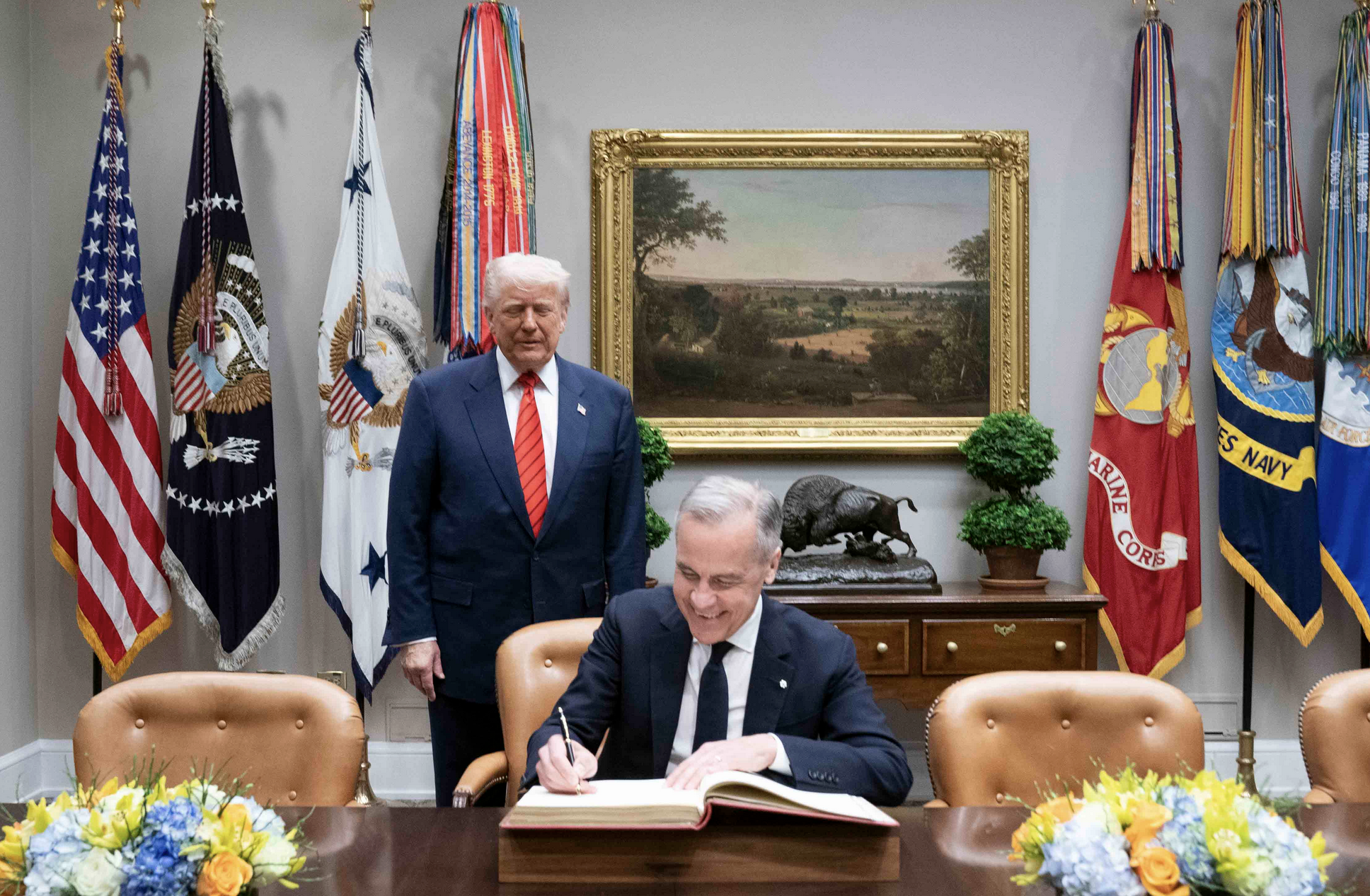

Prime Minister Mark Carney signs the White House guest book as President Donald J. Trump stands behind him in the White House on May 6, 2025. Photo by Lars Hagberg, provided by the Office of the Prime Minister © His Majesty the King in Right of Canada, 2025 (non-commercial use).
This article was first published by the Halifax Examiner on Dec. 18, 2025. Since then, the situation hasn’t improved, and Prime Minister Carney has stepped up the assault on the public service. Thousands of notices have gone out to federal public employees across government departments, slashing key climate and environmental research and policy programs. Those whose main source of information is National Post publications and other incurious, corporate and right-leaning media, tend to defend the cuts, parroting those media and social media messaging that glibly disparage the federal civil service as “bloated.”
Few would argue that there is always room for improving effectiveness and efficiency of large organizations – be they government departments or corporate bureaucracies. The Liberal government’s deep cuts to the public service is not that. It is a blunt force assault on crucial federal research and policy work, especially on anything involving environment, climate and sustainability, which looks more ideological than strategic. It is anything but well thought-out planning for an increasingly precarious future in a climate and biodiversity crisis, with a former neighbour and friend turned threatening foe.
In his much-touted and acclaimed speech at the World Economic Forum in Davos, Switzerland in Jan. 2026, Carney didn’t breathe the word “climate,” and referred only tangentially to the U.N. Conference of Parties (COP) that meets annually to hammer out policies to tackle the climate crisis, which he said was another of the multilateral institutions that is now “under threat.” Yet Canada’s prime minister didn’t bother attending the 2025 COP in Brazil.
Carney’s Liberals are doing the work of Conservatives, pleasing moneyed moguls and their cheerleaders by making deep cuts in Environment and Climate Change Canada, Infrastructure, Housing and Communities Canada, Fisheries and Oceans Canada, Agri-food and Agriculture Canada, Global Affairs Canada, and the Canadian Food Inspection Agency that reports to the Minister of Health, among others. Carney’s government is cutting seven key agricultural research facilities, cuts the National Farmers’ Union calls “disastrous.” This includes Nova Scotia’s Nappan Research Farm in Cumberland County, established in 1887, which does important forage and climate research.
By weakening the public service and Canada’s own research and scientific capacity that leads to strong federal policies and protections for Canadians, Carney is doing the opposite of nation-building, and making this country stronger in the face of continued threats from our increasingly hostile neighbour to the south, led by a volatile and unhinged bully.
It’s a long read, because it’s a long and complex story …
The Carney way
It’s beyond terrifying watching U.S. President Donald Trump and his bullying, brash, and crass coterie of odious hatemongers destroying decency, building autocracy, and dismantling democracy to Canada’s south.
The trouble is that it can be all-consuming watching the gilded, gold-plated shitshow in the U.S. That means it’s easy to miss what’s happening closer to home.
Liberal democracy is a fragile thing that can be undermined in many ways. Not all star a malignant narcissist spewing non-stop lies and insults, working with a tyrannical cabal of billionaires, tech bros and bigots and sycophants, to unleash non-stop “Truth Social” turmoil on a country – and the planet.
Democracy and genuine human progress on social, environmental, and climate issues can be weakened much more quietly, subtly, and methodically, and with much less media scrutiny than is being accorded the autocratic blowhard to the south.
These can also be undermined by sophisticated and polite people wearing pleasant smiles using polite words, charmers who post videos of themselves patting adorable kitties.
The damage can be done in an understated, toned-down way, without a lot of fanfare, with policies that increase economic disparity, channel money and power upwards, put people and their futures at risk, harm the environment, and torch the climate.
And so far, that seems to be the Carney way.
A smooth operator
Don’t get me wrong. I find Prime Minister Mark Carney, as a person, appealing (and not just because of the posts on social media of him with his kitty Nico).
Carney is smart, worldly, witty, and he knows how to navigate the corridors of power. He seems a likeable and decent human being, with a winning smile and oodles of charm. He doesn’t deserve the awful far-right conspiratorial stuff about him that abounds online. (I’m not providing links to any of it, because it’s dangerous, stupid, and doesn’t deserve to be publicized.)
Carney also wrote the award-winning book “Value(s): Building a better world for all,” which led me to believe he understood the importance of protecting people from moneyed interests and unfettered markets, the dangers of growing inequality, and the urgent need to tackle the climate crisis.

Cover of Mark Carney’s 2021 best-selling, award-winning book.
It’s not really fair to even use Carney’s name in a sentence that mentions Trump, a despicable and depraved excuse for a human being, beneath contempt.
What I’m saying is: The problem with Carney is not the man. The problem is how he’s been governing this country.
Slim political pickings
Before the Carney apologists start howling at me, let me also say that the prime minister is trying to govern in an extremely – beyond extremely – difficult and unprecedented time of crumbling democracies and alliances, an AI bubble and a pandemic of disinformation, global strife, nuclear tensions, and the climate crisis causing chaos, costing countless lives and billions of dollars.
And on top of all that, Canada’s closest ally and neighbour is threatening to annex the country.
Carney won the last federal election fair and square, or as fair and square as is possible in a first-past-the-post election that can give a political party an absolute majority with less than 40% of the popular vote.
And let’s also be realistic. The 2025 federal election offered Canadians slim political pickings. The traditionally progressive New Democratic Party had a leader who seemed to have gone missing from action. The Green Party remains tiny and poorly funded. The Bloc is a Québec-only party. And the Conservative Party had (and still has) a far-right Nasty courting conspiracy theories and acting like he was auditioning for a role as an underworld creature in Lord of the Rings.
Related: Canada’s 2025 federal election: where have all the climate issues gone?
An election against Trump and Trumpians
And of course there was also Trump, barking and snarling like a rabid dog just to our south, blathering on that our border – our country – shouldn’t exist.
Carney talked about “elbows up” and donned a hockey jersey. He sounded like the right person to defend Canada against Trump. In the absence of proportional representation that would have allowed Canadians to cast a ballot for their preferred candidate and party, many voted strategically for the Liberals, not because they wanted to, but because they feared the Trumpy party candidates on the right.

Prime Minister Mark Carney and Canadian actor, filmmaker, comedian and musician Mike Myers wearing Canadian hockey jerseys lean on the boards of an ice rink in Montréal, Québec, on Mar. 16, 2025.
Nine months after the Liberals won the election with a minority government, support for Carney remains quite strong, although support for the Liberals and Conservatives has recently dropped slightly. He’s managed to attract two Conservative MPs to his side, possibly because he’s been governing like a progressive conservative, smooth-talking his way right across the ideological divide and political aisle.
So far, he’s been able to get away with things that might – once upon a time Before Trump and when we still had a robust and healthy media landscape in this country – have evoked healthy debate.
His supporters see method in his conservative political plays. Some say he’s way ahead of the rest of us, playing 3D, even 4-D chess, and all will work out fine if we just keep on supporting him.
But will it?
I’ve seen some lists floating around online applauding Carney’s many “accomplishments” since he became prime minister in March 2025.
Do these hold up under scrutiny?
Let’s have a look.
Privatizing the public service
Buried in the 2025 budget is a paragraph about the Build Canada Exchange that will put “50 external leaders” from corporate Canada inside the “public” service.
The federal government is giving Build Canada, a platform launched by 27 tech bros and funded by major Canadian tech and industry players, exactly what it wants.
A Build Canada policy brief says that having these corporate leaders inside the public service will “improve the governments’ [sic] technical capabilities to accelerate AI adoption, strengthen defence capabilities, improve strategic procurement, negotiate optimal trade agreements and more.”
As The Tyee reported earlier this year, some of the tech CEOs who support Build Canada want an Elon Musk-style U.S. Department of Government Efficiency (DOGE) in Canada to slash government spending.
“Accelerated AI adoption” and DOGE bros inside the federal public service? Really? How is that a good thing?
It means explicitly infiltrating the public service with private sector actors, something that has always been frowned on because such “revolving doors” enable lobbying from within and increase regulatory capture of governments that are meant to serve those who elected them.
Private companies would continue to pay their salaries – hard to imagine that these people would ever work for a public servant salary – which evokes that old and worn but still-true adage, “He who pays the piper calls the tune.”
Slashing the actual ‘public’ service
This is happening at the same time Carney’s government is severely cutting the “public” part of the public service, the people who perform essential public services for Canadians. Over the next three years, the government plans to cut 30,000 federal public service workers, slashing critical services and putting Canadians at risk.
The government is cutting health funding for crucial government health agencies.
With Trump’s henchmen eliminating climate and weather, health and scientific bodies and regulatory agencies with which Canada has always collaborated, Carney’s government should be increasing spending on government services.
Corporate Canada already has a red carpet that leads straight into high-level offices in Ottawa. Lobbyists seeking public money and big favours have extraordinary access to elected officials and public servants every day, far more than do ordinary citizens who voted for those people and pay their salaries. Corporate lobbyists have no problem getting in to meet government ministers and officials in the prime minister’s office, influence policies, and get wads of public money.
In contrast, journalists – who want nothing more than answers to questions – are expected to communicate only with “media contacts” in government departments, by email. More often than not, those media contacts send back boilerplate bullshit in lieu of answers to journalists’ questions.
Once upon a democratic day, such a thing as Build Canada Exchange would have evoked a nationwide outcry about allowing foxes in henhouses.
The only media coverage I could find of this awful idea of giving corporate leaders even more access to the inner workings of the public service was this Tyee article, one from DeSmog, and this excellent piece in the National Observer.
And that’s just one of many worrisome pro-corporate and democracy-eroding moves Carney’s government has made.
A minister with oil and gas ties
Particularly alarming is the relentless assault on Canada’s policies protecting climate and environment, on which all of our futures, but especially those of our children and grandchildren, depend.
An early hint of things to come was Carney’s choice of Tim Hodgson as Energy and Natural Resources minister. Hodgson is Carney’s former banking and Goldman Sachs colleague, and he comes with oil and gas cred. Seeing him in a key ministerial post must have warmed fossil fuel industry hearts, if indeed those exist.
On Dec. 16, Julie Dabrusin, Canada’s minister of the Environment, Climate Change, and Nature, announced that the federal government was bringing in measures to address oil and gas industry emissions of methane, a greenhouse gas 80 times more potent than carbon dioxide. Alas, those measures came with loopholes to “offer more leeway to oil and gas producers” who didn’t like the stricter measures originally proposed by the former Liberal government under Justin Trudeau.
CBC reported that one of the fossil fuel companies that didn’t like those methane regulations because they were “excessively prescriptive” (isn’t that the point of regulations?) was MEG Energy.
And who was on the board of MEG Energy from 2016 to 2019? None other than Tim Hodgson, the man Carney recruited to run in the 2025 election, and then named Minister of Energy and Natural Resources.
Small world, cozy circles.
Canada is a ‘climate backtracker’
There is an excellent website – the Canadian Climate Backtracker – devoted to the depressing task of documenting Carney’s climate carnage and how it imperils Canadians.
It began on March 14, 2025, when Carney eliminated the consumer carbon tax. Realistically, that’s probably something he had to do to win the April election. The so-called “carbon tax” had been obsessively demonized by the man of a thousand silly slogans, Conservative Leader Pierre Poilievre, who led a vicious campaign against it.
Conservative politicians and premiers, including Ontario’s Doug Ford and Nova Scotia’s Tim Houston, also jumped aboard the “Axe the tax” train, using it as rage bait and a wedge issue to bash Justin Trudeau and his Liberal government.
Bankrolled by fossil fuel interests and boosted by algorithms and trolls, the campaign had convinced a majority of Canadians that the price on carbon was costing them money and causing rampant inflation.
In fact, it was a moneymaker for about 80% of households, and studies showed it was not a significant factor in higher food and living costs. It was also a key part of the former Liberal government’s program to help the country reach the Paris emissions target.
Still, Carney knew he could not win an election if he kept it in place, and he prides himself on being a pragmatist. So his first act as prime minister was to ditch carbon pricing.
Given all the climate backtracking Carney’s done since, hindsight suggests getting rid of the consumer carbon price was something he would have done anyway.
‘Flushing’ climate policies down the drain
The list of subsequent destructive measures is long. There was the abrupt end of the greener home loans, a pause on EV mandates, ending the two billion tree-planting program, abandoning the Canadian Pension Plan’s net zero target, and on and on.
Carney has also gutted legislation to keep greenwashing in check, allowing the country’s worst polluters to pump out misinformation and portray themselves instead as climate and environmental champions.
Nor did the prime minister attend the COP30 global climate change conference in Brazil. Maybe just as well for him. As was common during Harper era climate conferences, at COP30 Canada was back to earning the dishonourable “fossil of the day” award. Carney was accused of flushing “years of climate policies down the drain.”
‘Fire sale of our future’
Carney also signed a contentious Memorandum of Understanding (MOU) with Alberta’s premier, the duplicitous, transphobic, pro-Trump, human-caused-climate change-doubting and vaccine-skeptic Danielle Smith. The MOU has been dubbed “the climate sell-out of the century,” “a document of betrayal,” “a fire sale of our future,” and “the start of the race to the bottom on Canadian climate policy.”
The National Observer points out that the MOU “immediately exempts Alberta from clean electricity regulations and abandons the proposed cap on oil and gas emissions, while offering federal support to build a new bitumen pipeline from the oilsands, through the Rockies and dense forests of Indigenous nations, until it reaches the BC coast where the oil would be loaded onto tankers and shipped through a marine protected area.”

Prime Minister Mark Carney and Premier of Alberta Danielle Smith pose for a photo during the signing ceremony of the Canada-Alberta Memorandum of Understanding (MOU) on Nov. 27, 2025.
The memorandum promises all kinds of special favours to Alberta that are sure to increase emissions, further divide the country, and drive Albertans and Canadians “right off an economic cliff.”
Once a climate leader
The MOU seems to be doing nothing to appease Albertan Conservatives, and it’s almost beyond belief that Carney would sign such an agreement with Smith.
Carney made a name for himself as a climate leader in 2019, when he warned corporations that many of their assets would become worthless if they didn’t wake up to the climate crisis. Just after that, he went on to become the United Nations special envoy for climate action and finance.
And now he’s giving the “Pathways Alliance” of Canada’s biggest oil sands producers exactly the support for climate-killing projects they want.
It’s telling, but not surprising, that former Environment and Climate Change minister, Steven Guilbeault, quit Carney’s cabinet. And that progressive Liberal MPs concerned about the direction the government is taking on climate have formed their own “environmental caucus.” And that Canada’s Net Zero Advisory Body is bleeding members, including respected climate scientist Simon Donner and global climate campaigner Catherine Abreu. Both quit because of Carney’s sorry climate record.
For all Trump’s drill-baby-drill rhetoric and climate-killing acts, Canada still produces three times more oil per person than does the U.S. And now Carney is supporting a dramatic increase.
 Joan Baxter
 Like many rivers and water bodies in Nova Scotia, the Debert River was almost empty by the end of the summer of 2025, after weeks of extreme drought conditions.
Fast-tracking ‘major projects’
There is also Bill C-5, the One Canadian Economy Act, which gives Carney’s government extraordinary powers to designate projects as in the national interest so they can “bypass meaningful Indigenous consultation, limit environmental impact assessments, and expedite the development of carbon-intensive infrastructure.” One mining insider says Carney’s plan to use the bill to fast-track major projects “scares” him.
The Liberal government set up the new “major projects office,” and put at its head a woman the fossil fuel industry is sure to love, Dawn Ferrell. Ferrell is the former CEO of the Trans Mountain corporation. She oversaw the massive expansion of the Trans Mountain pipeline that carries fossil fuels from Edmonton, Alta. to Burnaby, B.C.
In 2018, in what turned out to be another futile effort to appease Alberta, Trudeau’s Liberal government took the controversial trans-mountain pipeline off the hands of U.S.-based Kinder Morgan for $4.7 billion. Since then, the cost of the pipeline expansion has ballooned to $34 billion. And the woman who ran the Trans Mountain crown corporation is now in charge of Carney’s list of “major projects,” chosen because they are supposedly “nation-building.”
Corporate-building, with a focus on oil and gas and extraction, is a more accurate description of many of the projects.
And not just Canadian corporations.
The proposed Ksi Lisims floating liquefied natural gas (LNG) facility located on the north coast of British Columbia “will be constructed, owned and operated by wholly owned subsidiaries of Western LNG, based in Houston, Texas.” The biggest investor in Western LNG is Blackstone, the world’s largest private equity firm. It’s run by Steve Schwarzman, an advisor and top donor to Donald Trump.
So, not a project that’s all that Canada- or climate-friendly, then.
Carney’s ‘carbon bomb’
Carney’s government also chose the “carbon bomb” LNG Canada Phase 2 as a “nation-building” major project. It will double Canada’s production of liquefied natural gas, which is primarily methane. Although the feds don’t say so on the major projects page, LNG Canada is a joint venture company of Shell, PETRONAS, PetroChina, Mitsubishi Corporation, and Korean Gas Corporation. Again, Carney’s government is promoting a fossil fuel project that is neither Canadian nor good for the climate.
Like a bow on the gift of the fossil fuel “nation-building” projects to the oil and gas industry, Carney’s government also included the North Coast Transmission Line (NCTL) on its major projects list. Touted as a way of reducing emissions, paradoxically this project will also boost “export-oriented LNG projects.” That includes Ksi Lisims, which we’ve already seen will be mostly in the hands of the world’s largest private equity firm that is run by a Trump-supporting billionaire.
Private equity roots showing
There are genuine nation-building projects that Carney could have chosen.
Among them: an east-west power grid, massive support for more wind and solar and grid-level battery development; more and better public transit; more support for greener homes and climate adaptation; breaking up monopolies and consolidation in sectors like food, communications, rental markets, and transportation to bring down costs for Canadians; clean drinking water for Indigenous communities.
Instead, Carney chose to promote pipelines, extractive industries, and extremely expensive nuclear energy. The latter would come from small nuclear modular reactors that don’t actually exist yet, and could cost Canadians billions of dollars that could immediately go into tried and tested renewable energy.
But is it a surprise that Carney’s priority projects are the stuff that private equity outfits love, costing tonnes of money, lots of it public to offset risks to them, while promising big profits? Not really. Before running for the leadership of the Liberal Party, Carney was chair and head of transition investing for Brookfield, Canada’s largest private equity firm.
Related: Taking on private equity, preventing American takeovers, and ensuring Canada is ‘Never 51’
Critical materials for U.S. Department of War
Carney’s record on standing up to Trump’s threats to use economic force to take over Canada is also less than stellar.
Another of the Carney government’s major projects is the Sisson tungsten mine project in New Brunswick. In May this year, the U.S. Department of War gave Northcliff, the mine proponent, close to $21 million to expand tungsten production for its domestic supply chain. Although tungsten has many civilian uses, the U.S. War Department sees it as a “critical material” because of its use in defence and aerospace applications, including munitions and armour.
Related: Critics take aim at PM Carney’s choice of New Brunswick tungsten mine for ‘major projects’ list
Seems odd Carney would think it wise or expedient to fast-track a controversial and environmentally harmful mining project that would strengthen the military powers of the country to our south that is threatening to annex us.
Not exactly “elbows up.” More like “kneeling down,” according to Jamie Kneen of MiningWatch Canada.
