Transport

A giant white pickup truck with raised suspension and massive wheels is parked in front of a small black car on a gravel parking lot.

This article was first published by the Halifax Examiner on October 28, 2024. It is the third and final article in a series looking at the ongoing trend in North America for ever bigger and taller pickups and SUVs, and some of the problems these pose both for human health and safety, and for the health of the planet. In this article we look at what governments in Canada could, at least in theory, do to tackle the bloat. Part 1 is available here and Part 2 is available here.

For 10 years Ben MacLeod watched from afar what was happening in his home town of Halifax, and was pleased to see HRM Council undertaking “progressive initiatives” on traffic safety, and the “gradual construction of the bike lane network.”

“It was exciting to see them moving in the right direction,” he said in an interview.

MacLeod, an urban planner and sustainable transportation advocate, had moved to Hong Kong in 2012, and in 2022 moved back to Halifax, where he grew up.

“I was excited to come back to see what’s changed,” he said.

What MacLeod didn’t bargain on, what made him “a little bit shocked” when he got home, however, was the “design trends” in the vehicles on the roads, and how prevalent big vehicles had become.

“Eighty-six percent of new vehicles in Canada are now SUVs [sports utility vehicles] and pickup trucks, which is shocking,” said MacLeod, who doesn’t own a car and mostly gets around on foot or on bicycle.

Read more

A large black and shiny GMC pickup in a parking lot, with a smaller silver Tucson SUV on its right. Behind the pickup, underneath the large green letters saying "Sobeys" is the entrance to the store.

This article was first published by the Halifax Examiner on October 25, 2024. 

This is the second in a series of three articles looking at the ongoing trend in North America for ever bigger and taller pickups and SUVs, and some of the problems these pose both for human health and safety, and for the health of the planet. In this article we look at what has driven the trend, and what it means for the climate, the environment, and our cities. Part 1 is available here, and part 3 here

In March 2022, Lisa Roberts – a former journalist and NDP MLA in Nova Scotia – wrote an opinion piece for the erstwhile Atlantic Canadian Saltwire media network. Her piece was called ‘Trail of tragedy follows pickup trucks.’

In it, Roberts said she winced when she heard about yet another pickup truck striking a cyclist in Halifax, sending the cyclist to hospital with “life-threatening injuries.” That reminded her of two other collisions that “shattered families” the previous year, both involving a pickup truck colliding with a pedestrian or a smaller vehicle.

“Larger, heavier vehicles mean more serious injuries and not for those in the larger, heavier vehicle,” Roberts wrote. “And trucks have gotten larger without being more functional. My grandfather’s pickup truck, which hauled firewood regularly, was easier to get into and had a longer bed.”

“For the sake of our health and safety, we have to talk about trucks,” Roberts urged.

So far, it appears Roberts’ plea for a meaningful conversation about large pickups has gone largely unheeded in this part of Canada.

Read more

A new and very shiny large silver-grey pickup in a car dealer lot, with a massive chrome grille, and the letters, GMC, in red in the middle of the grille.

This article was originally published by the Halifax Examiner on October 24, 2024. It is the first of a three-part series. Part 2 is available here, and part 3 here

Why this series

Just after the turn of the millennium, in 2002, American journalist Keith Bradsher wrote a book called High and Mighty. SUVs: the most dangerous vehicles and how they got that way.

The book begins: “Sport utility vehicles have taken over America’s roads during the last decade, and are on their way to taking over the world’s roads. The four-wheel-drive vehicles offer a romantic vision of outdoor adventure to deskbound baby boomers.”

Bradsher continues:

Yet the proliferation of SUVs has created huge problems. Their safe image is an illusion. They roll over too easily, killing and injuring occupants at an alarming rate, and they are dangerous to other road users, inflicting catastrophic damage to cars that they hit and posing a lethal threat to pedestrians. Their “green” image is also a mirage, because they contribute far more to smog and global warming … The success of SUVs comes partly from extremely cynical design and marketing decisions by automakers and poorly drafted government regulations. The manufacturers’ market researchers have decided that millions of baby boomers want an adventurous image and care almost nothing about putting others at risk to achieve it, so they have told auto engineers to design vehicles accordingly. The result has been unusually tall, menacing vehicles like the Dodge Durango, with its grille resembling a jungle cat’s teeth and its flared fenders that look like bulging muscles in a savage jaw…

Cadillac, a division of General Motors, rushed the Escalade onto the market in 1998, a little over a year after the Lincoln Navigator went on sale and was an instant hit. To make the Escalade, GM essentially put lots of chrome and optional equipment on a GMC Yukon Tahoe SUV. The Tahoe, in turn, uses the underbody and a lot of other parts from the full-size Chevrolet Silverado pickup truck. So Cadillac was essentially taking a [US]$20,000 work truck, tricking it up with lots of chrome, leather seats, and a fancy stereo, and selling it for close to [US]$50,000. This is how automakers have earned enormous profits on full-sized SUVs.

That was 22 years ago.

Since then, everything Bradsher predicted has occurred, possibly even exceeding his gloomy forecast. The vehicles have grown much bigger and even more menacing, and far more numerous, marketed to more and younger demographics. Compared with the front ends of today’s pickups, the grille of the Dodge Durango of yesteryear looks as harmless as a kitten’s nose. In 2024, the best-selling vehicles in the U.S. were the Ford F-series, the Chevy Silverado, and the Ram pickup trucks, with some starting at over $100,000.

In 2023, for every regular passenger car sold in Canada, six trucks — primarily larger pickups, SUVs, and vans — were sold. The same is true in Nova Scotia.

Across North America, road safety and environmental groups have been blowing the whistle on this vehicle bloat for years, and numerous studies show that big vehicles threaten lives and living environments. Even The Economist recently ran a front-page story about big cars and pickups killing Americans. But so far in Canada, regulators don’t seem to be listening.

This series of three articles looks at what is driving the trend for ever bigger and higher pickups and SUVs, and the many reasons this is bad for people, roads, cities, the environment, and the climate. We start by looking at the risks these oversize vehicles pose to other road users.  

Read more

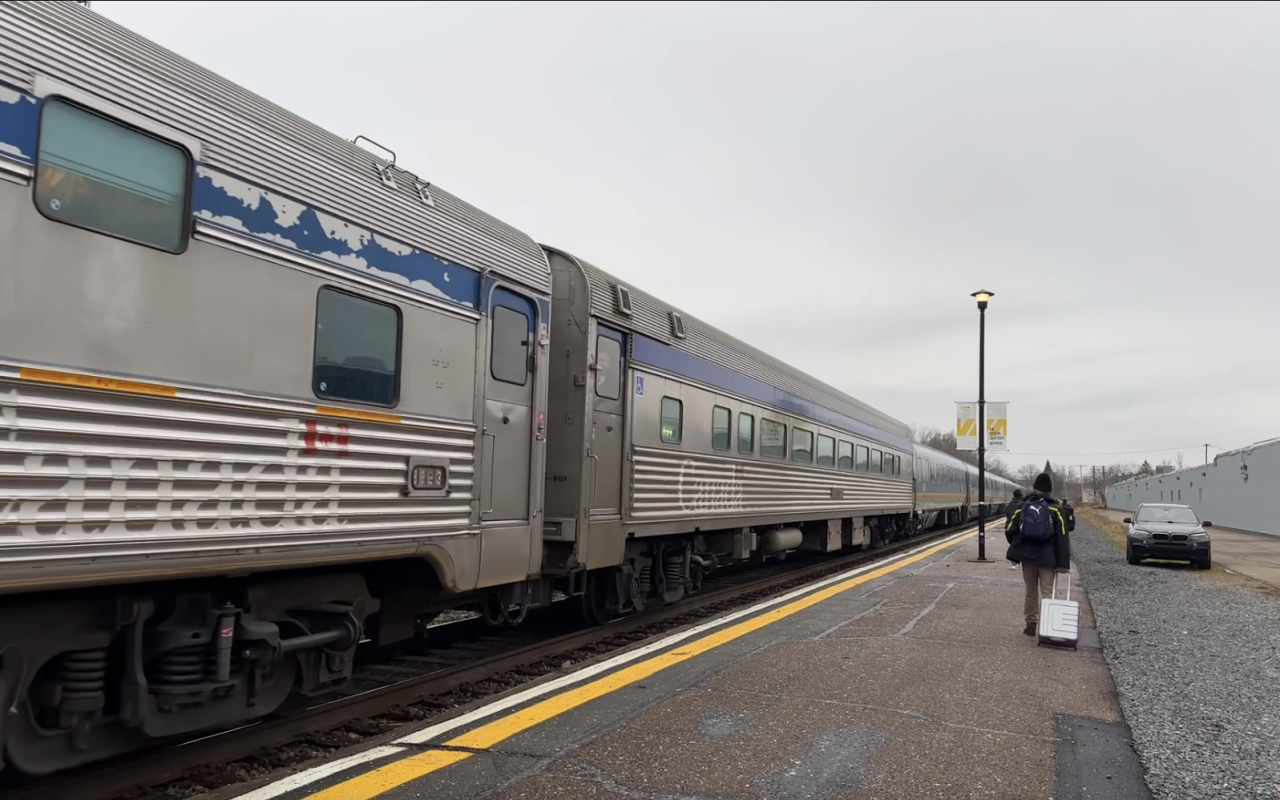
A man with a black jacket pulling a silver carry-on suitcase walks along a paved platform with his back to the camera, apparently heading to board the rather decrepit grey passenger train parked on his left, under a pale grey sky.

This article was first published by the Halifax Examiner, as the introduction to a series of three articles about passenger rail in Canada.

Just after Christmas 2023, my spouse and I boarded a VIA Rail train in Truro, Nova Scotia, bound for Montreal, with a connection to Ottawa for a family gathering. I hadn’t been on the Ocean – the train linking Halifax with Montreal – since 1998, when my family and I needed to get to Montreal for a flight to West Africa during some vicious winter weather, when highways were closed and flights cancelled.

Apart from that rail journey to Montreal a quarter century ago, and a few train trips in Cameroon, Indonesia, Kenya and Germany over the years, I have to dig way back into childhood memories to recall train travels.

The memories that surface are fond ones.

Our parents would put us kids on the train in Halifax, and we’d ride the rails to Oxford and Amherst, where our grandparents would pick us up. I am guessing our parents felt some relief as our train pulled away from the Halifax station, knowing we were safe on board, that they’d been spared the drive on what were then crowded and narrow two-lane highways, and they were in for a couple of weeks’ reprieve from loud, rambunctious children in the house.

As for us kids, we loved those train trips. They were adventures. We kept our noses to the windows, gazing at the province flashing by – as we skirted Bedford Basin, then one beautiful lake after another, and occasionally outpaced cars beside us on stretches where the tracks run parallel to Highway 2. We held our breaths (at least I did) on narrow rail bridges over deep gullies, as we moved towards and then through the magnificent Wentworth Valley.

All of which is to say, I was more than a little chuffed to be heading out on that same train track again at the end of 2023, this time as a much, much older person.

Several friends and family members asked why on earth we would opt for that long, 30.5-hour (at best) train trip to Ottawa when we could take a 1.5-hour flight from Halifax, or drive the distance in just over 13 hours, especially given that the train – with a sleeper – cost more than $1,000 per person.

I pondered that myself.

First, there’s this thing that Swedish speakers, inspired by climate champion Greta Thunberg, call “flygskam” – or “flight shame.” It’s the guilt one feels in an aircraft spewing greenhouse gas emissions into the atmosphere in the midst of the climate emergency. According to the European Union, “if global aviation were a country, it would rank in the top 10 emitters.”

In contrast, rail transport, is among “the most energy-efficient and lowest-emitting transport modes,” according to the International Energy Agency. So that appealed to me, even if I would learn later that this applies to modern and efficient trains carrying lots of passengers, and not necessarily to Canada’s antiquated long-distance diesel-powered trains.

In addition to the climate considerations, I also just don’t like flying any more. Maybe it’s my age, but for whatever reason I am increasingly fearful in the air, suspicious about the safety of the aircraft, ever more impatient with long security line-ups and body scanners and searches.

Third, I am wary – even terrified – of winter driving, especially in blizzards, and I’ve white-knuckled my way through too many of those. Nor do we have a car I really trust to get us to Ottawa without a problem.

So, for the first time in a very long time, I chose the train. I’m glad we did.

It was a back-to-the-future experience – in the same train cars I suspect I rode as a kid. I was bowled over by the courteous service from the VIA Rail crew on-board (and also the VIA reservation agents I spoke to on the phone when I booked the trip) that reminded me of a time – decades ago – before neo-liberalism took over. Back before so many public corporations and services were privatized, before passengers somehow became “customers,” and everything from support service to cleaning was outsourced to the lowest bidder, often the cheapest, most exploitive employer. The VIA Rail employees seemed genuinely happy to be looking after passengers, which they did as consummate and caring professionals.

But we hadn’t even boarded the Ocean in Truro when we started to hear horror tales about it. A security person on the platform decided that for some reason known only to him, it would be a good idea to tell a bunch of passengers that the train was always late, and had been known to back up all the way from New Brunswick when locomotives stopped working, and about a recent accident at a crossing that meant passengers had to take a bus. This didn’t sound promising at all.

And no amount of good food and good service from friendly VIA Rail staff could mask the reality that the Ocean is plagued by problems.

There were long delays on the rails, a long stretch of poor tracks in northern New Brunswick where the online VIA trip tracker informed us we were mostly going 23 kilometres an hour, and I wondered how sound those ancient train cars could really be. When I asked some of the VIA crew members about the state of the tracks and the trains themselves, which seemed not to have changed in half a century, they hinted at enormous risks facing passenger rail in our country.

Related: Federal transport plan fails to give VIA what it needs to succeed

This raised so many questions. How had we gone from a country that ostensibly existed only because of its transcontinental railway – at least that was the myth perpetuated in songs like Gordon Lightfoot’s “Canadian Railroad Trilogy” – to not having a single passenger train that crossed from one coast to another? Why was Canadian National sold off in 1995? And why was VIA Rail created in 1977 as a Crown corporation? Why did VIA Rail trains that transported people have to yield to Canadian National and Canadian Pacific freight trains? When and how had passenger train service in Canada become so diminished, and what are the prospects for VIA Rail and affordable public passenger rail transport in Canada? When other countries around the world are busy developing and expanding high-speed publicly-funded rail networks, why are Canada’s passenger trains so few, so old, and so damn slow?

Ultra-modern white electric train locomotive with headlights on at modern train platform, and the silhouette of a man wearing train conductor uniform standing on the platform beside the train. Credit: Rikku Sama on Unsplash

Modern high-speed electric train at a station in Japan. Credit: Rikku Sama on Unsplash

Back home in Nova Scotia, I set out to find people who could answer some of those questions.

A series of articles that looks at the past, present and future of Atlantic Canada’s and national passenger rail service is the result of those conversations.

The first in the series looks at the state of passenger rail in Nova Scotia and VIA Rail’s train that runs between Montreal and Halifax.

Read more

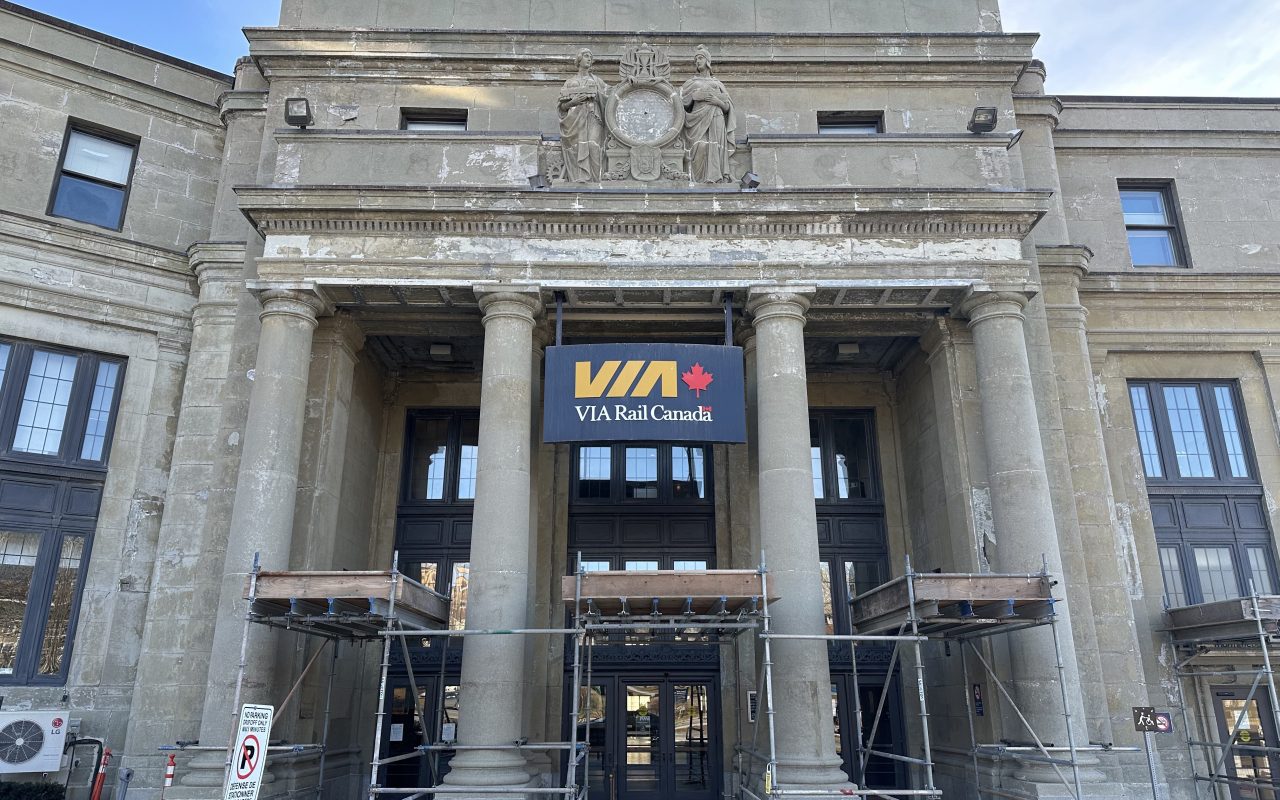
Grandiose facade of a concrete building, with pillars and empty place where a clock may once have been. The sign "VIA Rail Canada" with the yellow logo and red maple leaf is suspended between two columns, and construction is ongoing, as scaffolding is in place between the columns. Credit: Joan Baxter

This article, the first of a three-part series on passenger rail in Canada, was originally published by the Halifax Examiner. The introduction is here.

It’s a Friday morning, which means the Ocean – VIA Rail’s thrice-weekly passenger train to Montreal – is sitting on the tracks at the VIA station in Halifax, almost ready for boarding.

But I’m not here today to take the train; I’m here to talk trains with Tim Hayman.

Hayman is a board member of the citizen transportation advocacy group Transport Action Canada and president of its regional chapter, Transport Action Atlantic. He’s met me in the elegant and spacious VIA Rail station, a grandiose hall adjoining the once-grand Nova Scotian Hotel, now owned by Westin.

Both were built by Canadian National Railways in the late 1920s. CNR (now CN) was founded as a Crown corporation in 1919, bringing under one roof several railways previously owned by the government, and others the government acquired after they went bankrupt.

As Hayman and I speak, passengers trickle in with their luggage, ready to board the Ocean, scheduled to depart for Montreal at 1pm

A blue screen mounted in the upper corner of a building, flanked by a stylized old-fashioned lamp on the right, and upper casement doors windows on the left, showing Departures for VIA Rail trains from Halifax, namely a single train to Montreal at 13 hours, shown "on time"

At the Halifax VIA Rail station, three times a week the departure screen shows the Ocean train leaving for Montreal at 13h. Credit: Joan Baxter

Hayman tells me he wishes he were getting on the train, as he always does, no matter how many times he’s made the Ocean journey over the years.

And he’s made it a lot.

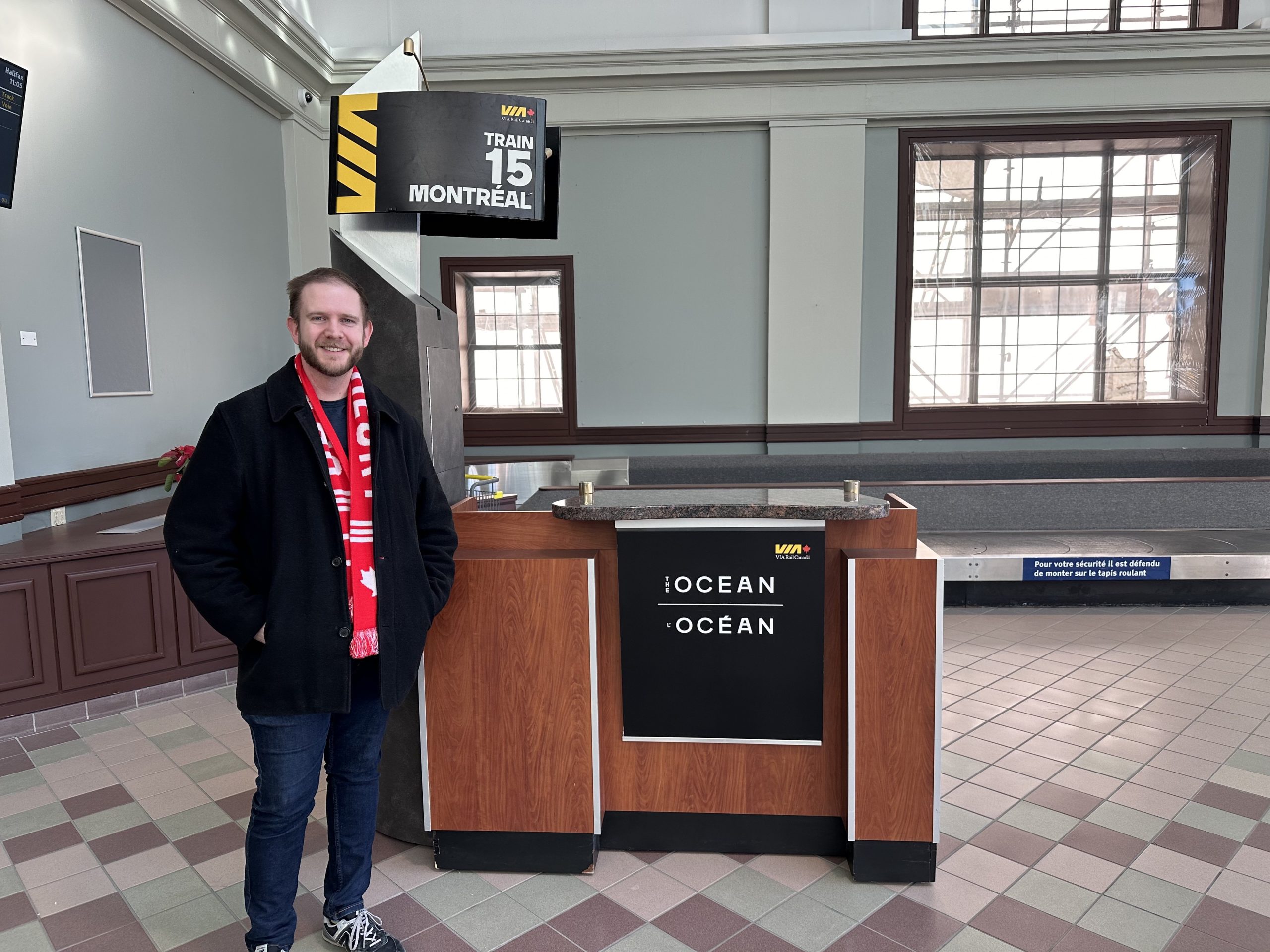
A smiling man with short dark hair, wearing a black thigh-length jacket and a red and white scarf, blue jeans and sneakers, stands with his hands in his jacket pockets in front of a wooden desk with the words "The Ocean" on it, and underneath an overhead sign saying "VIA Train 15, Montréal.

Tim Hayman at the Ocean departure gate in Halifax VIA Rail station. Credit: Joan Baxter

Hayman documents his many trips in a colourful and fascinating “Tim’s train travels” blog that tells tales – some of them harrowing – about the ups and downs, the joys and also the woes, the delays and major disruptions that are part of the experience of travelling a train as antiquated as the Ocean, and running on tracks where VIA trains have to cede priority to massive freight trains owned by CN, which owns the tracks.

Even with all the pitfalls Hayman details in his blog, he loves the Ocean.

And he is happy to count the ways.

Read more

Large sign with dark blue background, and VIA in yellow letters, then a red maple leaf, and underneath the words "VIA Rail Canada" in white lettering. Behind the sign, a red brick building and a very blue sky. A white seagull sits atop the sign.

In this second article in a series about passenger train service in Canada – past, present and future – we look at just how dramatically passenger rail service has been diminished, the myriad problems VIA Rail faces, and at the efforts by some parliamentarians to support and protect the Crown corporation responsible for passenger rail service in the country. Part 1 is available here. This article was first published by the Halifax Examiner.

If Green Party leader Elizabeth May had her way, VIA Rail would have its very own legislation, something the Crown corporation has not had since its creation in 1977.

A VIA Rail Act, she says, would enable the Crown corporation to fulfil its mandate to provide modern safe, efficient, climate-friendly and reliable passenger rail service in Canada.

That’s why, in 2022, May tabled Bill C-326 – the VIA Rail Act – that she hoped would accomplish just that

Alas, as a private members’ bill, the VIA Rail Act didn’t go anywhere after first reading, and is still languishing on the table.

But May hasn’t given up hope for improved and expanded passenger rail in Canada, as she says in a phone interview from her home in British Columbia.

Read more