

 We were meeting under a thatch roof at the makeshift headquarters of Addax Bioenergy in northern Sierra Leone. Aminata Koroma, Social Liaison Officer for the company, was extolling for me the virtues of the project that was transforming great swaths of farmland, grassland and woodland around us into massive sugarcane plantations. Addax Bioenergy, part of the Addax & Oryx Group headed by Swiss billionaire Jean-Claude Gandur, had recently leased more than 50,000 hectares in the area, with the intention of processing the sugarcane to produce ethanol for export to Europe, where it would be used to fuel vehicles. Koroma was more than enthusiastic about the project, despite a good deal of local opposition among farming communities.
I was challenging her about the wisdom of transforming the diverse countryside, much of it used for farming, into monocultural plantations of sugarcane. She responded that there would be “environmental corridors”, and that they were going to have a “tree-planting day”.

To make way for its sugarcane plantations in Sierra Leone, Addax Bioenergy had to fell many trees, including ones that produce valuable food such as kenda.
I countered that I had seen the bulldozers taking down valuable indigenous leguminous trees that did not lend themselves well to planting, such as the locust bean tree, or Parkia biglobosa. This tree is cherished through West and Central Africa because of its many medicinal properties, the sweet edible yellow powder that is harvested from its pods, and its seeds that are fermented and prepared to produce an extremely nutritious and tasty condiment that has long been a mainstay in local cuisines. In Sierra Leone it’s known as kenda.
“Nobody’s planting those trees, the ones that produce kenda,” I said to Koroma. “They grow naturally, they’re not cultivated.”
“Why are you thinking about producing kenda?” she retorted. “ I mean, we call it the poorest man’s food. There is even a song that says, ‘kenda and dry rice, na poor man’s choice’.” She said that the only people in Sierra Leone who ate kenda were people who could not afford the modern alternative, the chemical-ridden Maggi cubes from Nestlé. For her, traditional foods such as kenda had no place in a modern diet. She seemed to think my defence of the condiment and the diverse local farms that produced traditional crops meant I was backward. Against progress and development.

 Not even 50 kilometres from the disputed land lease taken out by the Siva Group in Kpaka Chiefdom in Sierra Leone’s Pujehun District, where angry youth leaders and local chiefs are denouncing their Paramount Chief for signing away their precious farmland, there is similar discontent and dis-accord over a land deal in the Malen Chiefdom. There, Socfin Agricultural Company (SL) Ltd, or SAC, has leased 6,575 hectares and converted more than half of that into monoculture oil palm plantation. It is now seeking to lease and plant an additional 5,500 hectares, for a total of 12,000.
 Atop the Siva Group is another reputed billionaire, the
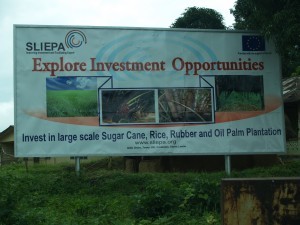


 So it was that in late 2009, Sierra Leone’s President Ernest Bai Koroma took the podium at the Sierra Leone Trade and Investment Forum at the Queen Elizabeth II Conference Centre in London, England. The country was still better known internationally for “blood diamonds” and a brutal civil war they fuelled, than for its impressive peace-building efforts in the ten years since the war ended. President Koroma wanted to change that.