Food

Previously Billionaires at play in the fields of the poor (part 3) Frank Timis

In this, the fourth in a series of six articles on foreign investment in Sierra Leone, Joan Baxter profiles another of five billionaire investors, Swiss national Jean Claude Gandur and his investment in Sierra Leonean farmland to produce ethanol for export to Europe.

King of Sugar and Bioenergy

While some foreign investors focus on underground riches in Sierra Leone, other moneyed foreign investors are seeking to further their fortunes by acquiring large tracts of arable and well-watered land for industrial agriculture in the country. They’re part of what has been called a global land grab that began after the combined financial and food crises of 2007 and 2008, when investors sought safe and profitable places to park their wealth. The land rush is also being driven by and capitalizes on the increased production of agrofuels or biofuels, as well as fears of future food and water shortages caused by climate change, environmental degradation and population growth.
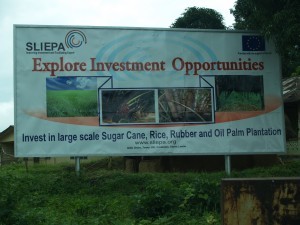
P1011460-300x225

 Land- and water-hungry investors have found welcoming arms with the Government of Sierra Leone [pdf], which has resulted in a spate of large land deals in the country. Despite a great lack of transparency in many of the deals, it can be estimated using actual leases and investor fliers that in the past few years, foreign investors — primarily from Europe, the UK, China, India — have taken out leases of 50 years, some with possible extensions up to 99, on more than 1.2 million hectares of land, nearly a quarter of all the arable land in Sierra Leone. [i]

Read more

Food aid as big business

For more than half a century, the American government has operated something called “Food For Peace”. A 2004 booklet from the United States Agency for International Development (USAID) that celebrates the 50th anniversary of the program, proclaims that it is a “unique combination of American compassion together with the unmatched efficiency of our nation’s farmers . . . an unbroken chain of humanity stretching from this country’s fertile fields to hungry families half a world away. In the end, hope is what America has promised, and hope is what Food for Peace delivers around the world every day.”

Or so they say.

It is absolutely true that in emergency situations food aid saves lives. It can also be an important tool in development projects that involve providing food for work on labour-intensive community works or to encourage school attendance among vulnerable groups. If food aid is purchased locally or regionally, it can also help spur local agricultural production and improve rural livelihoods.

But food aid is also very, very big business and it’s also a foreign policy tool.

Read more

Half of the population of Sierra Leone was displaced by the brutal and senseless civil war that raged in the country from 1991 until 2002. During that time, more than two million people fled their villages and farms as rebels terrorized them and others joined the fray. Because of this and the destruction of the nation’s infrastructure, by the end of the war, Sierra Leonean farmers were producing just over half of the staple rice consumed in the country. By 2007, they had upped their output and were producing nearly three-quarters of its rice needs. And that, thanks mostly to small-scale farmers toiling in rice swamps and mixed upland farms. They did so without much support from anyone; at that time family farming just wasn’t a priority with major donors and governments.

Then in 2008, in the wake of the global financial meltdown and fuel and food crises, some new and powerful players suddenly turned their attention to farms, or rather, to land as an asset in their portfolios. Foreign investors suddenly saw farmland as the new “gold, only more profitable” and set about acquiring enormous tracts of arable land in Africa, some just speculating on the new asset and some because they planned to turn the land into giant offshore farms that would turn Africans into lowly wage labourers (if they were lucky) or landless peasants on their own land in their own countries. Foreign donors and African governments alike began to clamour for the transformation of the family farm from a way of life into agribusiness, and large mechanized farms that would conform to economies of scale.

Jusu-Kamara-close-V-225x300The experts drawing up the blueprints for millions of lives in Africa almost invariably repeated the assumption that young people prefer city life and that they don’t want to work the land the way their parents and their forefathers did. Sierra Leone’s national rice development strategy was developed jointly by Japanese International Cooperation and the Alliance for a Green Revolution for Africa, that like AGRA was funded by the Rockefeller and the Bill & Melinda Gates Foundations. Neither of these have much in common with the very people they claim to be trying to help, namely the unemployed Sierra Leonean youth or the hard-working Sierra Leonean farming families.

This doesn’t prevent them from speaking on behalf of the youths and farmers. In a blueprint for a rice strategy in the country, the Coalition for African Rice Development make this statement: “The existing labour intensive farming is no longer attractive to the youths who are drawn to urban areas for easier jobs.”

Easier jobs? Doing what? Working as a watchman for a foreign-owned security company twelve hours a day, six days a week, for just over one dollar a day? Peddling on the streets a backpack of pirated DVD collections from Asia? Making a few cents a day selling top-up credit for mobile phones? Or worse, begging? Stealing to feed themselves?

Read more

The AP headline read “Thousands of caterpillars seized at UK airport”. Under it was the story that UK Border agents had seized several bags of dried caterpillars that they found in the luggage of a 22-year-old man from Burkina Faso when he landed at Gatwick Airport. Countless media outlets picked up the report and ran with it, from the Washington Post to the Jordan Times, from Fox News to the Winnipeg Free Press. The Independent in the UK produced its own version of the story and gave it a catchy headline that set a jocular tone, “Monkeys in my pants? No, just 94 kg of caterpillars in my luggage.” It cited an insect expert from the Natural History Museum who said that the caterpillars were likely mopane worms, the larvae of emperor moths, species name Gonimbrasia belina.

The British Government deemed the story so important that it ran a version on its official Home Office page and earnestly reported that the discovery of the dried caterpillars at Gatwick was “among the largest of its kind at the airport”. This struck me as curious — were smuggled caterpillars a common occurrence at Gatwick then?

Read more