Climate Change

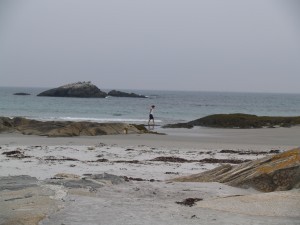
The beautiful worn stones of a Nova Scotia beach, this one in Guysborough County

BY: Joan Baxter

P8194822-300x225On a balmy, overcast August day, I stood at Port Joli Head in the Kejimkujik Seaside park on Canada’s Atlantic coast, nibbling on delectable little beach peas, staring out over the windswept beaches of white sand and rounded weathered grey stones, and at blue waves exploding white against magnificent rocks of granite as the ocean waters nudged relentlessly at the southern shore of Nova Scotia.

Just offshore, fat seals lounged on rocky islands, ensconced there like complacent and over-indulged Roman emperors. I envied them their thick layers of blubber that allowed them to slip happily in and out of the frigid crystalline waters, for their ability to live without a single thing but their own thick coats and their seal brains. And being in the national park, they didn’t need to worry about human predators as they lazed about on the rocks. They completely – almost insolently – ignored the human beings gaping at them through binoculars.

The park’s interpretive signs informed hikers that 18,000 years ago this area was covered by a sheet of ice three kilometres thick, and the land mass we now call Nova Scotia extended fifty kilometres out to sea. As the ice slowly retreated about 13,000 years ago, the sea level rose and the waters crept ashore, swallowing up land, even as the land itself was rising, heaving a sigh of relief as the weight of the ice diminished. That was naturally-induced climate change, caused by minute alterations in the earth’s tilt in its orbit that have brought about cycles of ice ages and periods of warming. Such change is gradual, happening over thousands of years. Life forms can adapt to the changes by evolving or finding new niches in which to live.

But that has not always been the case in our planet’s history. Between about 440 and 65 million years ago, there were five Great Extinctions, each of which wiped out the majority of the species on earth at the time. Scientists believe these were triggered by cataclysmic events — giant asteroid impacts and the eruption of flood basalts when molten rock bursts through the earth’s surface — that involved the release of enormous amounts of dust and sulphur dioxide into the Earth’s atmosphere. But it was the dramatic climate change the cataclysms invoked that caused the great extinctions.

Today, we’re in the middle of what is called the Sixth Great Extinction. The cataclysmic event causing it? We, the people. Human beings. Homo sapiens sapiens, literally “wise or knowing humans”.

Read more

Previously: Billionaires at play in the fields of the poor (part 4): Jean Claude Gandur

In this, the fifth in a series of six articles on foreign investment in Sierra Leone’s natural resources and farmland, Joan Baxter profiles another of five billionaire investors in the country, Indian national Chinnakannan Sivasankaran and his quest to make his Siva Group into the largest player in the production of  palm oil by leasing land and establishing oil palm plantations from Papua New Guinea to Sierra Leone to South America.

 King of Oil Palm

The magnitude of the ambitions of other investors working to get their hands on Sierra Leonean real estate in the form of farmland pales next to those of the Siva Group. Siva is an Indian conglomerate with offices in Singapore, ”a big, dirty Asian tax haven”. [i] The Siva Group is working to become ”the largest global player in the production of sustainable palm oil”. [ii] According to its country representative in Sierra Leone, it is acquiring more than 200,000 hectares of arable land for oil palm plantations in the country,[iii] with agreements that will give Siva control of the land for 50 years with possible extensions up to 99. This is part of the Group’s quest to plant one million hectares of oil palm in Africa and Asia.[iv]

P1012091-300x225Atop the Siva Group is another reputed billionaire, the enigmatic Indian entrepreneur Chinnakannan Sivasankaran. [v] A former employee of the Group says that Sivasankaran does all he can to avoid appearing on the Forbes List. [vi] He is one of the largest landowners in The Seychelles,[vii] and the owner of three private jets. He was the first to join Dragon Blaze, an exclusive ultra-luxurious lifestyle company based in Malaysia, which gives its members, limited to a maximum of 50, the right to use their fleet of private jets and yachts.[viii]

Read more

Previously Billionaires at play in the fields of the poor (part 3) Frank Timis

In this, the fourth in a series of six articles on foreign investment in Sierra Leone, Joan Baxter profiles another of five billionaire investors, Swiss national Jean Claude Gandur and his investment in Sierra Leonean farmland to produce ethanol for export to Europe.

King of Sugar and Bioenergy

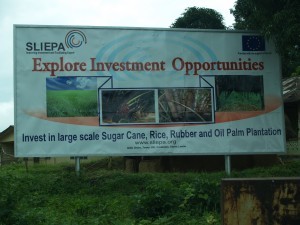
While some foreign investors focus on underground riches in Sierra Leone, other moneyed foreign investors are seeking to further their fortunes by acquiring large tracts of arable and well-watered land for industrial agriculture in the country. They’re part of what has been called a global land grab that began after the combined financial and food crises of 2007 and 2008, when investors sought safe and profitable places to park their wealth. The land rush is also being driven by and capitalizes on the increased production of agrofuels or biofuels, as well as fears of future food and water shortages caused by climate change, environmental degradation and population growth.

P1011460-300x225

 Land- and water-hungry investors have found welcoming arms with the Government of Sierra Leone [pdf], which has resulted in a spate of large land deals in the country. Despite a great lack of transparency in many of the deals, it can be estimated using actual leases and investor fliers that in the past few years, foreign investors — primarily from Europe, the UK, China, India — have taken out leases of 50 years, some with possible extensions up to 99, on more than 1.2 million hectares of land, nearly a quarter of all the arable land in Sierra Leone. [i]

Read more

There is a great deal of buzz about Africa’s economic awakening, with some countries experiencing double-digit growth in gross domestic product that is being driven by waves of foreign capital, as investors from Asia, Europe, North America, the Middle East and also Latin America descend on the continent. Many of the investors are after natural resources, mineral and oil riches and also farmland. This raises the question: is the foreign investment benefitting the continent or is it just another scramble for Africa, the last stage of colonialism? This, the first in series of six articles, Billionaires at play in the fields of the poor, investigates how foreign investment is playing out in one small African country. It looks at five billionaire investors, their big investments and at what’s in it all for Sierra Leone.

Part 1. Sierra Leone on a silver platter?

Africans and their leaders have every reason to be fed up with the negative way their continent has been portrayed and viewed by the outside world. It is definitely time that they tried to undo the damage by painting pictures that highlight the continent’s many strengths and riches.

PVB-GN_06-002-300x225So it was that in late 2009, Sierra Leone’s President Ernest Bai Koroma took the podium at the Sierra Leone Trade and Investment Forum at the Queen Elizabeth II Conference Centre in London, England. The country was still better known internationally for “blood diamonds” and a brutal civil war they fuelled, than for its impressive peace-building efforts in the ten years since the war ended. President Koroma wanted to change that.

“Our soils are fertile and our land under-cultivated, offering ideal investments in rice, oil palm, cocoa, coffee and sugar,” he declared.  “Our ground is rich in minerals: iron ore – the third largest deposit in the world; bauxite, rutile, gold and yes, diamonds. Our shores boast 400 kilometres of white sandy beaches, just waiting to be developed for tourism . . . Our seas are some of the most well-stocked and under-fished in the world”.

Read more