Previously Billionaires at play in the fields of the poor (part 3) Frank Timis
In this, the fourth in a series of six articles on foreign investment in Sierra Leone, Joan Baxter profiles another of five billionaire investors, Swiss national Jean Claude Gandur and his investment in Sierra Leonean farmland to produce ethanol for export to Europe.
King of Sugar and Bioenergy
While some foreign investors focus on underground riches in Sierra Leone, other moneyed foreign investors are seeking to further their fortunes by acquiring large tracts of arable and well-watered land for industrial agriculture in the country. They’re part of what has been called a global land grab that began after the combined financial and food crises of 2007 and 2008, when investors sought safe and profitable places to park their wealth. The land rush is also being driven by and capitalizes on the increased production of agrofuels or biofuels, as well as fears of future food and water shortages caused by climate change, environmental degradation and population growth.
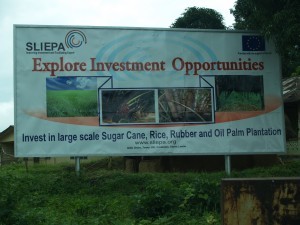
Land- and water-hungry investors have found welcoming arms with the Government of Sierra Leone [pdf], which has resulted in a spate of large land deals in the country. Despite a great lack of transparency in many of the deals, it can be estimated using actual leases and investor fliers that in the past few years, foreign investors — primarily from Europe, the UK, China, India — have taken out leases of 50 years, some with possible extensions up to 99, on more than 1.2 million hectares of land, nearly a quarter of all the arable land in Sierra Leone. [i]



 So it was that in late 2009, Sierra Leone’s President Ernest Bai Koroma took the podium at the Sierra Leone Trade and Investment Forum at the Queen Elizabeth II Conference Centre in London, England. The country was still better known internationally for “blood diamonds” and a brutal civil war they fuelled, than for its impressive peace-building efforts in the ten years since the war ended. President Koroma wanted to change that.

 The experts drawing up the blueprints for millions of lives in Africa almost invariably repeated the assumption that young people prefer city life and that they don’t want to work the land the way their parents and their forefathers did. Sierra Leone’s national rice development strategy was developed jointly by Japanese International Cooperation and the Alliance for a Green Revolution for Africa, that like AGRA was funded by the Rockefeller and the Bill & Melinda Gates Foundations. Neither of these have much in common with the very people they claim to be trying to help, namely the unemployed Sierra Leonean youth or the hard-working Sierra Leonean farming families.