Africa

Canada and the world have lost a great medical researcher, and a remarkable man. In my life – and I’ve had a long one – I’ve met only a handful of people I admired as much as I did Frank Plummer. This is my tribute to him.

By Joan Baxter

February 6, 2020. When I heard this week that Dr. Frank Plummer had died, the loss hit hard, although I hadn’t seen him in two decades and knew him for only a couple of years when my family and I were living in Kenya.

That Frank had died suddenly while in Nairobi to deliver a keynote speech at the annual meeting at the collaborative centre for research and training in HIV/AIDS/STIs at the University of Nairobi – his old stomping grounds – made his passing somehow even more poignant.

Screenshot of the University of Manitoba web page in tribute to Dr. Frank Plummer, an alumnus and a U of M Distinguished Professor of medical microbiology, Distinguished Professor Emeritus and former Canada Research Chair in Resistance and Susceptibility to Infections.

It was in Nairobi in the mid-1990s that I met Frank, a fellow Canadian. Through our kids and mutual friends, we met the Plummer family, and would get together at parties or for weekend outings in the Kenyan countryside.

At first, I had no idea  how renowned he and his work were, although he had been in Nairobi for more than a decade doing research on HIV/AIDS. It was through our mutual friends – not Frank himself – that I learned just who he was, a globally and highly respected microbiologist whose work had made world headlines in 1993.

At the time, I was working as a science writer for an international research organization headquartered in the Kenyan capital, and was eager for some writing projects that involved more creativity than did the mostly technical reports and academic articles that took up my working days.

Then one day in 1995, Frank asked me if I would consider writing a book about him and his work on HIV/AIDS. He said a European publisher had approached him and asked if he would be willing to pen an autobiography. He told me he wasn’t interested in doing that. Not then. He was too busy.

Read more

November 18, 2019

Morila gold mine in Mali, West Africa, 2002. Photo: Joan Baxter

This book chapter is the result of a visit to the Morila gold mine in Mali nearly 18 years ago, and is excerpted from my 2010 book, “Dust from our eyes – an unblinkered look at Africa,” published by Wolsak & Wynn in Canada and worldwide by Fahamu Books, which was shortlisted for the Dayton Literary Peace Prize in 2009. I decided to republish it here because I regret to say that based on the extensive research I’ve been doing on the gold mining industry in the past few years, it looks as if not much (if anything) has improved since then. I first wrote this story for the BBC, following a visit to the Morila gold mine when it was operated by South Africa’s AngloGold and Randgold. Today, the Morila gold mine is operated by Canada’s Barrick Gold, and is a “joint venture company held by Barrick (40%), AngloGold Ashanti (40%), and the State of Mali (20%).” The economic disparities, and the environmental, social and political havoc that such gold mines cause, are all contributing factors to the horrendous insecurity that now prevails in Mali, Burkina Faso and Niger (where Canadian gold mining companies are so prevalent), causing widespread suffering – and death. If I were writing it today, I would probably entitle it, “Gold: all that glitters causes death and devastation.”

All that glitters … is taken away

… the very term investment badly distorts what’s really going on. Plundering, looting and exploiting the non-renewable resources of Africa is a far more accurate description. Gerald Caplan

In my fifth year in Mali, in late 2002, I finally obtained an invitation to accompany the country’s new minister of mines and a team of Malian journalists on a day trip from Mali’s capital Bamako to Morila, the country’s newest big gold mine.

On the short flight to the mine, I found myself seated beside a South African employee of the South African mining giant Randgold, who told me he and his wife had recently applied for Canadian citizenship and that he now lived in Toronto – when he wasn’t in Mali. He said things were deteriorating in South Africa, “if you know what I mean,” and that he and his wife, as white South Africans, felt their futures were in Canada.

He went on to tell me about the wonders I was about to experience at Morila, especially the man-made lake that was filled with water pumped 40 kilometres from a small river, a tributary to the River Niger. And as for the clubhouse, that was something to behold; he was very proud of it because he helped to design it. He called it the “Sahelian Club Med.” There were pleasure craft and a wharf on the man-made lake, he said, and lovely watered gardens, a fine bar and restaurant, with food, wine and other drinks flown in from South Africa. He said he often drove down from Bamako in his Land Cruiser to spend weekends there.

Read more

By Joan Baxter

February 18, 2018

This has been adapted from Chapter 21 of my book, “A Serious Pair of Shoes: An African Journal,” published in 2000 in Canada. I am publishing it again now after being inspired by a fascinating BBC article about Babani Sissoko, “The playboy who got away with $242 million – using black magic,” by Brigitte Scheffer.

Crowds line the road from Bamako’s international airport to the centre of Mali’s capital.

Bamako, Mali. First came a couple of his more modest jetliners, a Fokker and a Boeing, screaming in for touchdown on the overheated runway. Then, from out of the wild blue yonder ‑ or to be precise, the brown dusty haze ‑ came that monstrous, white 747 barrelling in to land. The hot blasts of wind threatened to remove my skirt and blow it all the way to Timbuktu. I put my notebook away with a sigh, clutched at my skirt, and moseyed along after the throng already off and running towards the jumbo that had brought their prodigal son back home.

Here was Babani Sissoko, a mystery man who had reportedly left Mali penniless a decade earlier, now arriving direct from Miami with his own fleet of planes from his own personal airline, which was named after his native village. He had just been released from prison in Florida, where he’d done time, charged with attempting to bribe American customs officials to expedite the export of two military helicopters to Africa.

Ex‑con, yes, but also a hero. He’d made headlines in the US by handing out huge sums of money to charities or anyone that took his fancy ‑ school marching bands or disadvantaged children or just women he met on the street or in expensive jewellery boutiques in Miami or New York. And now he was coming home, bringing with him ‑ so it was said ‑ billions of dollars.

It was Friday morning, November 21, 1997. Word had it that there would be another jumbo landing on Sunday. That one would be bringing his luggage‑ luxury cars, construction equipment and lavish gifts that he was going to give away to his own people.

Read more

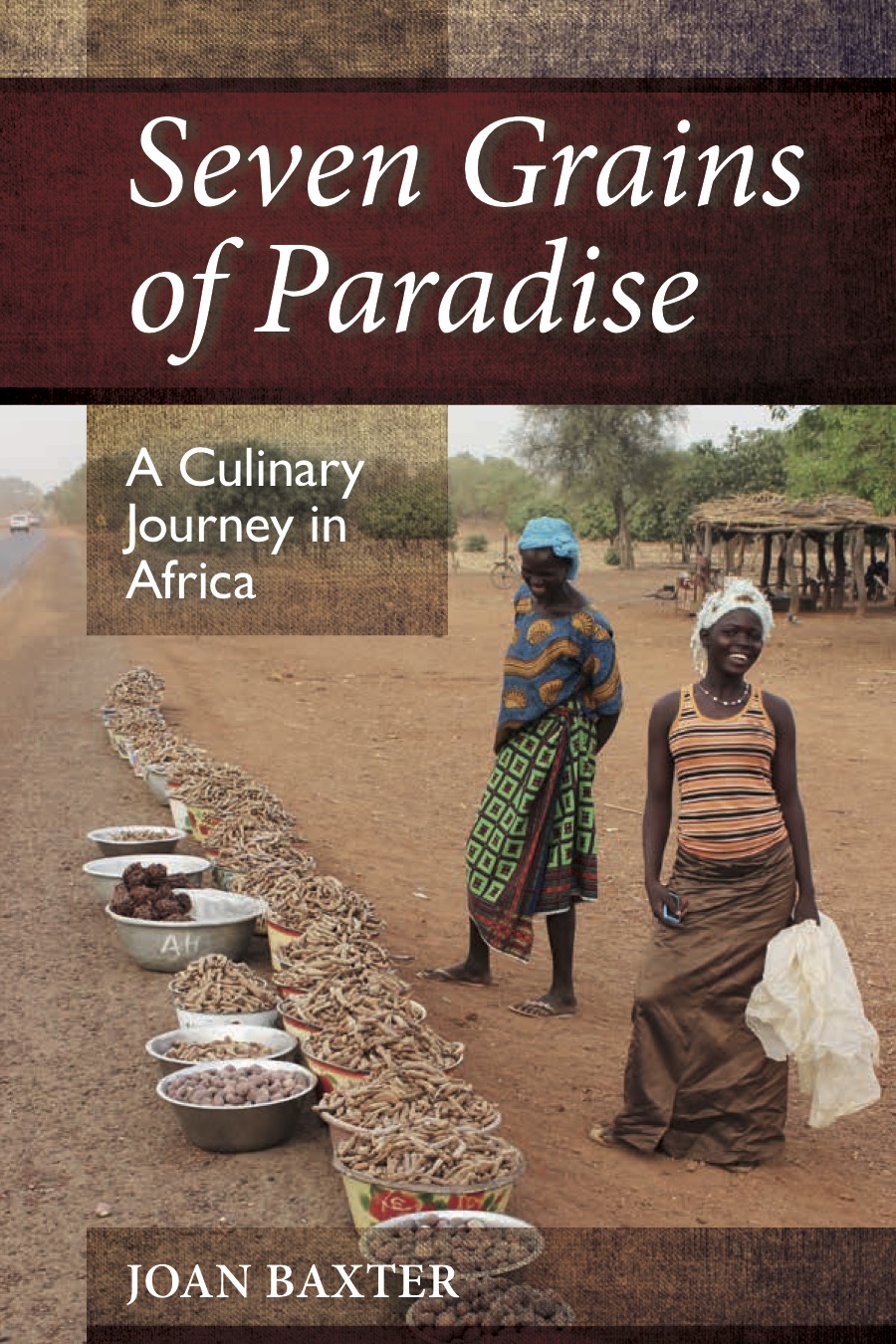
Seven Grains of Paradise-Proof4.oct 25BBC Focus on Africa interviews Joan Baxter, a former correspondent for the program, about her new book, “Seven Grains of Paradise: A Culinary Journey in Africa”, which celebrates Africa’s food, farms, crops and cuisines.

Listen to the interview here: August 17, 2017 BBC Focus on Africa interviews Joan Baxter

The book is available as an e-publication online from Amazon.com and Rakuten Kobo, and in Canada from Amazon.ca. It is available in print from many independent bookstores across Canada.


Read more

MM_Flying booksFeb13

On Friday, August 4, 2017, from 7 until 9 PM, Pottersfield Press will be launching the latest book by Joan Baxter, “Seven Grains of Paradise: A Culinary Journey in Africa” at Mabel Murple’s Book Shoppe & Dreamery, which was opened in early July by the renowned Canadian author and children’s poet, Sheree Fitch, and her husband, Gilles Plante.

This is the first book launch to be hosted at Fitch’s immensely popular new bookshop at 286 Allen Road in the village of River John in Pictou County, Nova Scotia, Canada.

Fitch says she is pleased to host this event because Baxter is a “local writer and a friend” and she believes this book has “global significance.”

sheree book shoppeBaxter says she is “thrilled” to be launching this book, her sixth, in rural Nova Scotia, at a location she describes as “beyond magical,” thanks to “the incredible imagination, energy, enthusiasm and efforts that Fitch and Plante invested to create what is sure to become a major literary and tourism destination for the entire province, if not the entire country and beyond.”

She describes her book as a “celebration of African foods, farms, farmers, crops, cooks and cuisines.” And while it may fly in the face of many global media headlines, she says, “Africa has much to teach the world about healthy eating. Of the ten countries with the healthiest diets on earth, nine are African, some of them among the monetarily poorest nations on earth.”

Seven Grains of Paradise-Proof4.oct 25“Seven Grains of Paradise” draws on stories collected over the more than three decades that Baxter worked, lived and learned in Africa. It explores the riddle of a continent that is known more for hunger than for its rich and diverse foods and cuisines, and for having discovered and bred many of the staple foods and drinks consumed daily around the world.

The culinary journey of learning, eating and drinking takes readers from the fabled city of Timbuktu on the southern edge of the Sahara Desert, to the diamond fields of Sierra Leone, from the savannah of northern Ghana to the rainforests of Central Africa.

It pays homage to the farmers, cooks and friends who schooled, guided and mentored her along the way.

“This is an eye-opening book that everyone should sturdy carefully to learn how so called advanced cutleries exploited and still exploit this natural rich continent. Highly recommended.” Professor Hrayr Berberoglum, Winesworld Magazine

Baxter says the book doesn’t shy away from the very real problems of food insecurity, hunger or malnutrition brought on by conflict, poverty, unfair trade and climate change, which today plague not just Africa but many other parts of the world.

“While the book focuses on the immense potential of family farming and locally produced food in Africa, it also documents the growing risks they face,” she says.


The author visiting the farm of Martin Kamara (right) in Gbematambadu, eastern Sierra Leone. Photo credit: Theophilus Gbenda

About the author: Joan Baxter is a Nova Scotian journalist, science writer, anthropologist and an award-winning author. She has written six books and many research reports on international development and agriculture in Africa. She has reported for the BBC World Service and contributed to many other media, including the CBC, Le Monde Diplomatique, Toronto Star, The Globe and Mail, The Chronicle Herald.

 Seven Grains of Paradise: A Culinary Journey in Africa is available at bookstores in Canada, or online at:

Paperback & Kindle Edition:

Chapters Indigo: http://bit.ly/2vFrjES

Amazon (Canada): http://amzn.to/2gZNC4K

Kindle Edition only:

Amazon (International): http://amzn.to/2vWUkuY

Paperback only: Nimbus Publishing (distributor) http://bit.ly/2tWoBIX


Read more

BY Joan Baxter

July 12, 2017

(This article is the first of two adapted excerpts from the book, Seven Grains of Paradise – A Culinary Journey in Africa, available in print and Kindle edition at Amazon.ca, as an e-pub globally from Amazon.com and Kobo, and in print in Canada from Nimbus.)

Seven Grains of Paradise-Proof4.oct 25Type “Why is Africa” into Google and these are the top four phrases with which it fills in the blank: “so backward,” “such a mess,” “so poor,” and “so underdeveloped.” Change the query to “Why can’t Africa,” and Google finishes that question with: “grow food.”

Depressing stuff, but it’s not Google’s fault that such negative stereotypes abound. They go back many decades, if not centuries, and obviously still persist to shape online searches. And they’re as misleading and wrong now as they’ve always been.

First, Africa is an immense and diverse continent, which is no more “backward” (whatever that really means) or more of a “mess” than many other parts of the world. Many African countries may be monetarily poor, but the continent is enormously rich in culture and resources, and parts of it are catching up, if not surpassing, other more “developed” countries, depending, of course, what exactly we mean by development.

And as for the notion that Africa can’t grow food, that’s so far off the mark that it’s hard to know where to start to debunk it. But I’ll try. In 2015, a landmark study that examined diets in 187 countries around the world in 1990 and again in 2010 found that nine of the ten healthiest were in West African nations.

Read more