Mining


This article first appeared in the Halifax Examiner on February 7, 2019.

British Columbia taxpayers are on the hook for $40 million to clean up the disaster of Imperial Metals failed tailings pond at Mount Polley. Photo courtesy Cariboo Regional District.

Late last year, Nova Scotia’s Minister of Energy and Mines, Derek Mombourquette, penned an op-ed that his department sent out to the media. As I mentioned in the Halifax Examiner Morning File on January 16, 2019, the opinion piece was entitled “A little piece of Nova Scotia, everywhere,” and it claimed that the province’s mining industry was “something we can all take pride in, especially with the new Mineral Resources Act.” It would encourage “responsible mineral exploration and development” in the province.

“The new act also cuts red tape and saves industry money,” he said.

The minister went on to try to reassure readers that this did not mean the government would relinquish its duty as regulator or hesitate to stand up to industry to make sure things were done right for the citizens of the province and their descendants after the mines closed and the companies walked away from, say, toxic tailings facilities left behind at open pit gold mine sites.

“Companies that develop a mine in Nova Scotia are required to have a plan to restore the site once it closes,” wrote Mombourquette. “They must also set aside funds with the province, also called security, to do this work, even if the company goes out of business. A company’s plan will be reviewed every three years.”

Sounded promising.

Read more


(This article first appeared in the Halifax Examiner on January 25, 2019.)

The salmon museum in Sherbrooke, Nova Scotia, is now at the heart of the NOPE campaign to prevent a proposed open pit gold mine from going in near the St. Mary’s River and jeopardizing its salmon recovery. Photo: Joan Baxter

For many years, when the St. Mary’s River Association (SMRA) held meetings in Sherbrooke on Nova Scotia’s Eastern Shore, the group members’ purpose was primarily to report on the headway they were making in their efforts to achieve their vision of “Health for our river, the Atlantic salmon and our community.”

Members would gather in the St. Mary’s Education and Interpretive Centre, which serves as a “salmon museum” that volunteers from the community built in 2001 with financial help from supporters of their cause.

The interpretive centre is a testament to the storied history of the river. It is filled with exhibits of fly-fishing gear through the ages, photos of species at risk such as wood turtles, and of huge Atlantic salmon specimens that could once be caught in the river. There is also a display devoted to famous anglers who have fished in the river over the decades, including the legendary American baseball player, Babe Ruth.

Past issues of SMRA’s annual newsletters offer a glimpse of the astounding amounts of unpaid time, energy, and enthusiasm that people in rural communities devote to trying to make their small parts of the world better and healthier places. The tone of the newsletter is always upbeat, the reports brimming with optimism and positivity.

The SMRA meeting held this week was not.

This time the subject was not the St. Mary’s River and how to improve it, but Atlantic Gold’s proposed open-pit gold mine and how to stop it.

Read more

People carrying banners and signs as well as Mi'kmaq flag gather with fists raised in front of a mountain.

 This is the last in a series of four articles on the 21st century push for mining and quarrying in Nova Scotia. Earlier versions of these articles appeared in May and June 2018 in the Halifax Examiner and the Cape Breton Spectator. (I am pleased to say that this series of four articles earned a silver Atlantic Journalism Award in Excellence in Digital Journalism: Enterprise/Longform.)

How the mining lobby is working to undermine environmental protection in Nova Scotia

On a cold day in late November 2017 a couple of dozen people gathered near Kellys Mountain in Victoria County, on Nova Scotia’s Cape Breton Island, for the first in a series of protests over possible mining or quarrying on the mountain.

They were reacting to comments from the executive director of the Mining Association of Nova Scotia (MANS), Sean Kirby, that mineral deposits on Kellys Mountain were “blocked forever” because they were locked underneath the Kluscap Wilderness Area, which had been created in 2015.

According to MANS, Cape Breton’s economy was being “harmed” by protected wilderness areas, losing out on 80 jobs that could be created if a quarry were allowed on Kellys Mountain, where there were 2 billion tonnes of aggregate.[1]

Outraged by Kirby’s suggestions that part of the protected area could be swapped for another piece of land so that Kluscap Mountain could be opened up for quarrying, members of the First Nation organization, Reclaim Turtle Island, organized the demonstration on Highway 105, with support from the Council of Canadians.

The majority of participants were First Nations activists and Warriors, who came from all over the province, including Waycobah, Port Hawkesbury, Sydney, Halifax and Sipekne’katik.[2]

Speaking to CTV during the November 25 protest, Suzanne Patles said that the mountain is sacred to her people, the departure point for Kluscap, and home to the Kluscap Cave where the Mi’kmaq perform ceremonies.

Another protest on December 16 drew about 40 people, who gathered on Seal Island Bridge.

In a telephone interview, Madonna Bernard of Waycobah First Nation, tells me that the police helped control traffic on the bridge while the demonstrators conducted a ceremony for Kluscap Mountain.

Read more

This is the third in a series of four articles on the 21st-century push for mining and quarrying in Nova Scotia on Canada’s Atlantic coast. Earlier versions of articles in this series appeared in May and June 2018 in the Halifax Examiner and the Cape Breton Spectator(I am pleased to say that this series of four articles has been shortlisted for an Atlantic Journalism Award in Excellence in Digital Journalism: Enterprise/Longform.)

Part 3. Gold in the hills or clean water in the rivers? Citizens take on government geologists in northern Nova Scotia

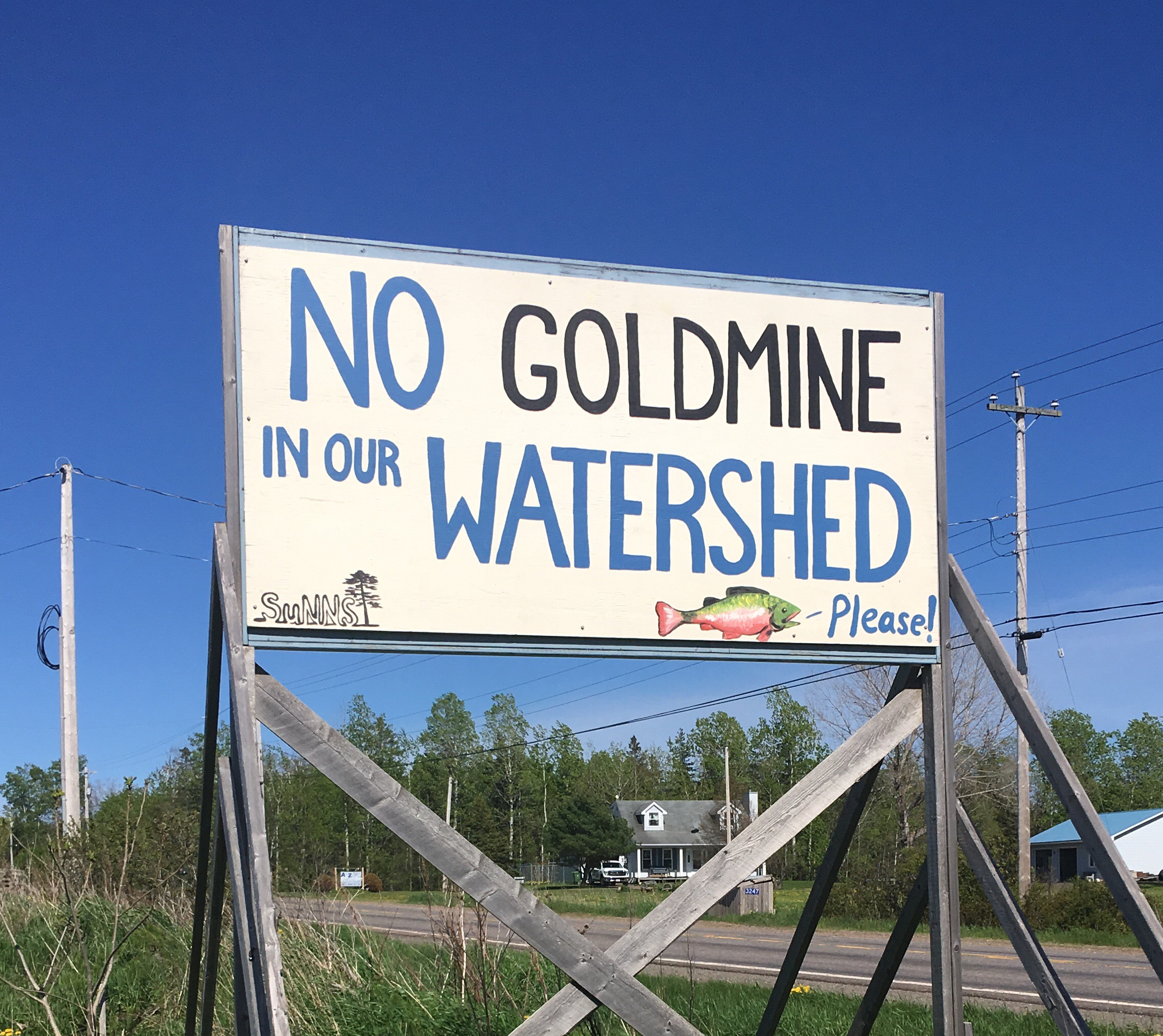
Article 3 photo SuNNS no mining sign

The news broke in November 2017 on the front page of the free monthly community paper, The Tatamagouche Light, in an article written by Raissa Tetanish under the headline “Gold in the hills?”

“The hills” are the Eastern Cobequid Highlands in northern Nova Scotia, a mostly forested area of 30,000 hectares (74,132 acres), stretching from the Wentworth ski hill to Earltown.[1]

Tetanish reported that, not only did geologists from the provincial Department of Natural Resources (DNR) think there was gold in the Cobequid Hills, they had been prospecting there for six years. And now, reported Tetanish, DNR was preparing to invite mining companies from around the world to come and do more advanced exploration.

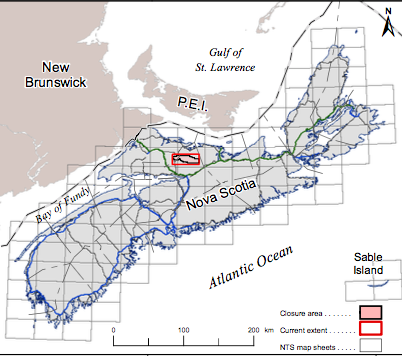
Screenshot taken from DNR geological map showing enclosure area slated for gold exploration in the Cobequid Highlands in Nova Scotia.

In 2016, the government had closed the area to any other prospecting while DNR geologists did their own hunting for gold. About half the enclosure area was the French River watershed, which supplies the village of Tatamagouche its drinking water. Concerns about the water supply aside, the geologists were “enthused” by what they’d found and “optimistic for the future,” reported Tetanish.

The article explained that there were plans to hold an “open house” to inform citizens about the findings, and the geologists said they would be promoting the “opportunity” at the next Prospectors and Developers Association of Canada (PDAC) convention, which would be held in Toronto in March 2018. After that there “could be a Request for Proposals (RFP) to see if there’s interest from mining companies.”

Garth DeMont, a geologist with the Geoscience Branch of DNR (which was moved to the Department of Energy and Mines in July 2018), was quoted as saying, “All we need is the discovery of one significant gold vein and the Cobequids will light up.”

Read more

There’s a 21st century gold rush starting in Nova Scotia on Canada’s Atlantic coast, just as industrial gold mining is increasingly coming into disrepute around the world. It has been described as an “environmental disaster,” which often leads to contamination of water sources on which life depends. This is the second in a series of four articles on mining and quarrying in Nova Scotia. Earlier versions of these articles appeared in May and June 2018 in the Halifax Examiner and the Cape Breton Spectator. (I am pleased to say that this series of four articles has been shortlisted for an Atlantic Journalism Award in Excellence in Digital Journalism: Enterprise/Longform.)

Part 2. Going for gold

Screenshot of BNN interview of Atlantic Gold CEO Steven Dean (left) at the 2018 Prospectors and Developers Association of Canada (PDAC) convention.

The CEO and chairman of Vancouver-based Atlantic Gold Corporation, Steven Dean, a man with a history of international coal and metal mining and former president of Teck Cominco, was being interviewed by Andrew Bell of the Business News Network (BNN).[1] Dean was talking up his company’s first gold mine, named Touquoy after a French miner who worked the deposit in the late 1800s, which had just gone into production in Moose River, Nova Scotia.

The interview was held at an ideal venue for Atlantic Gold to showcase its new open-pit gold mine, the first ever in Nova Scotia: the 2018 convention of the Prospectors and Developers Association (PDAC) of Canada in Toronto, the global mining industry’s “event of choice.”

Bell expressed amazement at the low cost – $550 – of producing an ounce of gold at the Touquoy mine. Dean told him the mine would produce about 90,000 ounces a year which, at current gold prices, would make it a “profitable mine” with about $90 million in “operating cash flow.” And, said Dean, Atlantic Gold planned to enter its second phase of operations by 2022, with more mines operating in the area, producing a total of 200,000 ounces a year.

Read more

There’s a 21st century gold rush starting in Nova Scotia on Canada’s Atlantic coast, just as industrial gold mining is increasingly coming into disrepute around the world. It has been described as an “environmental disaster,” which often leads to contamination of water sources on which life depends. This is the first in a series of four articles on mining and quarrying in Nova Scotia. Earlier versions of these articles appeared in May and June 2018 in the Halifax Examiner and the Cape Breton Spectator. (I am pleased to say that this series of four articles has been shortlisted for an Atlantic Journalism Award in Excellence in Digital Journalism: Enterprise/Longform.)

Part 1. Welcome to the gold rush

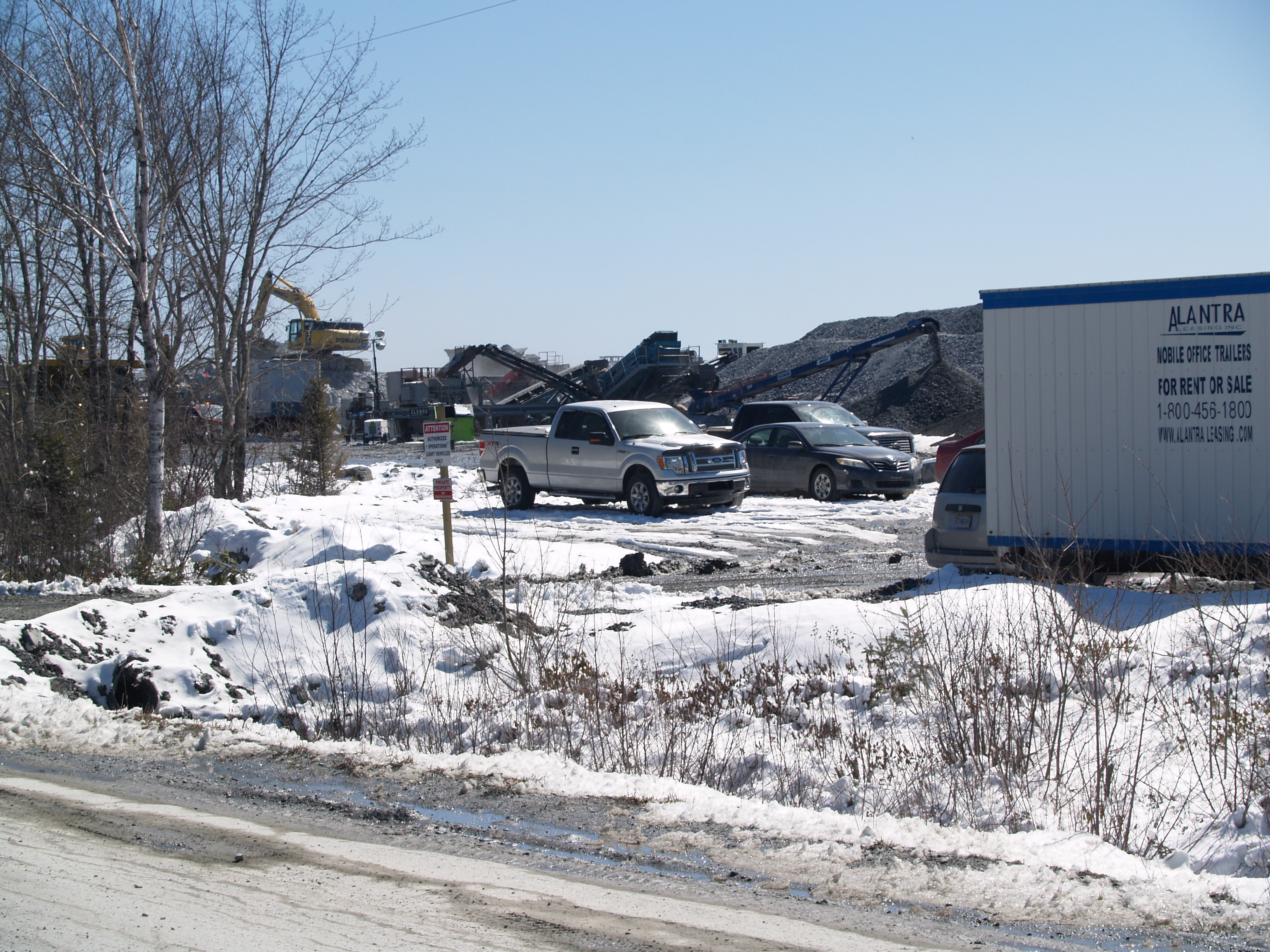
Atlantic Gold’s open pit gold mine in Moose River, Nova Scotia, one of four the company has planned, and one of six proposed for the province’s Eastern Shore. Photo: Joan Baxter

In October 2017, Vancouver-based Atlantic Gold opened Nova Scotia’s very first open pit gold mine, one of four it has planned for the province. The Touquoy mine, about 100 kilometres from Halifax, is named after French miner Damas Touquoy, who first worked the Moose River deposit back in the late 1800s.[1]

Officiating at the opening ceremony, and energetically applauding the cutting of the ribbon, was Nova Scotia’s Minister of Transport and Infrastructure Renewal, Lloyd Hines.

Years earlier, Premier Darrell Dexter’s NDP government in the province gave the mine a helping hand when then minister of natural resources, Charlie Parker, issued a vesting order allowing the mining company to expropriate land that had been in the Higgins family for 120 years.

It looks as if Nova Scotia, where small-scale, underground gold mining persisted from the mid-1800s until the 1940s, is once again pinning a good part of its future on gold.

Read more